Yolanda Yang
Mrs. Christopher
HHSE 2
18 January 2019
The Hero of Our Generation: Nelson Mandela
“‘They are our gods and goddesses,’ says Snyder’” (Vanity Fair). In Julian Sancton’s essay “Why America worships Superheroes”, he argues that superheroes are our “Gods and goddesses” and that they are our role models. They exemplify the values of our country, and the values we have ourselves. A hero has traits that most people hope to possess, which is why we look up to them. Therefore we must think about who we consider as a hero, because it can define who we are as a person and what we believe in. Who are our gods and goddesses? A big characteristic of a hero worthy of our love is someone that possess traits that are rare, traits that have to be earned and not given. To be a hero, they do not have to have a glorious background or a perfect personality, instead, most come from humble beginnings, and create their name as a hero. A hero could be a volunteer that helps mentally challenged kids, or a wealthy person donating lots of money to a charity. A hero can be well known, but can also be an average person trying to support themselves. Heroism can be found in someone that sacrifices oneself for the good of others, and never speaks a single word about what they have accomplished. Heroes need to be humble, otherwise people may feel belittled by their constant bragging and gloating, thus repelling the people around them. A hero that is worthy of his title is someone that is humble, even after doing something great for the world and someone that can settle differences for the better of others.
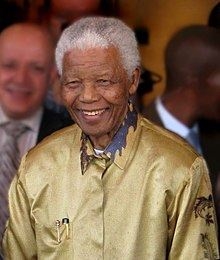 Nelson Mandela the day before his 90 birthday (May 2008) in JohannnesburgWikipediaIn society today, many people would consider Nelson Mandela as a god and someone to look up to. Nelson Mandela was born as Rolihlahla Mandela on July 18, 1918 in a small Thembu village called Mvezo. His father, Gadla Henry Mphakanyiswa, was the chief of Mvezo, and his mother, Nosekeni Fanny, was his father’s third wife. Mandela was the first in his family to receive formal western education, attending the University of Witwatersrand. It was when he was there that he learned about the political movement of apartheid, graduating with a degree in law. In 1944, he joined the African National Congress (ANC), in which they tried civil disobedience to end apartheid, which wasn’t effective. He then became an outspoken leader in ANC, which ultimately lead to his arrest in November 1962, serving 27 years between different jails such as Robben Island and Pollsmoor Prison. After being released by president F.W. de Klerk in 1990, they went on to win the Nobel Peace Prize "for their work for the peaceful termination of the apartheid regime, and for laying the foundations for a new democratic South Africa." (Nobelprize.org), and becoming the first black president of South Africa in 1995. Remaining humble, he continued to help others, and continued to “fight against social injustice and poverty in South Africa and beyond through fundraising organizations such as the Nelson Mandela Foundation and the Nelson Mandela Children's Fund” (CNN), leaving a lasting impact on the world. A hero must possess humility, otherwise their pride will get the best of them. One example is in the Odyssey, when Odysseus became too prideful after defeating the Cyclops. Odysseus became too prideful after defeating the Cyclops and had to let him know who he was, thus angering the gods. A hero must also be able to move on from the past. If a hero holds grudges towards something in the past, they will never be able to accomplish more and help more people, instead they will be thinking about something that is not thinking about him anymore. Through his ability to be humble about his accomplishments, and his ability to forgive others and move on from the past for the better of others, Nelson Mandela truly resembles heroic traits and inspired the world to fight for what is right.
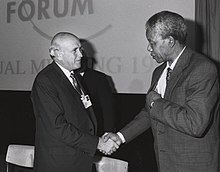 Nelson Mandela with F.W de Klerk (1992)WikipediaEven After saving the world, Nelson Mandela is able to remain humble upon countless recognition. His choice of words during his inaugural speech displayed humility through words: “We succeeded to take our last steps to freedom in conditions of relative peace. We commit ourselves to the construction of a complete, just and lasting peace” (Nelson Mandela Inaugural speech). In Mandela’s inaugural speech, the word that he kept on repeating is “we”. The word “we” is significant in this instance because he never said that he did it nor that he and the other important people ended apartheid. Mandela truly believed that everyone played a role in the end of apartheid, no matter how big or how small. It could simply be a white person choosing not to discriminate, or a black person moving on and forgiving, little by little, apartheid came to an end with everyone’s efforts. Mandela never believed that he himself was not the only person that stopped apartheid, being the humble man he was, he credited everyone for their work and efforts, even though he played the biggest part in ending this time of discrimination. When Mandela appeared on The Oprah Winfrey Show, Oprah noticed truly what a humble man he is: “Oprah: ‘When Mr. Mandela arrived today, he said to the producer that met with him in the room and he said, ‘What is the subject of today’s show?’” (1:52-1:58). To most others, the subject of the show that day would be Nelson Mandela if he was even there. However, Mandela took into inquiry of why is he here and asked a producer. Mandela never truly understood how big of an influence he is to the world, because he believed that the others played just as big of a role as him. Mandela’s traits of humility also showed how selfless he is, constantly thinking about others rather than himself and believing that it’s the natural thing to do. Knowing that being arrogant repels people, Nelson Mandela chooses to be humble and inspire others to not be self-absorbed, but rather someone that cares about others and helps them for the good of society.
 Mandela's prison cell in Robben IslandWikipediaMandela is able to forgive the white people of South Africa for their past actions of mistreatment, which many would hold grudges for. For the better of the nation, Nelson Mandela is willing to forgive the people that hurt him the most: “Courageous people do not fear forgiving, for the sake of peace.’ Nelson Mandela” (50 quotes by Nelson Mandela). In order to benefit South Africa as a whole, Mandela, for the sake of peace, forgave the people that have mistreated him. Many people will forever hold grudges towards people, which means the issue is never resolved. For Mandela, he has to be selfless and forgive the people that has permanently defected his health by putting him in prison, which he should never have been in. Mandela never said that he forgave others, but he displayed so using his careful choice of words, “We have triumphed in the effort to implant hope in the breasts of the millions of our people. We enter into a covenant that we shall build the society in which all South Africans, both black and white, will be able to walk tall, without any fear in their hearts, assured of their inalienable right to human dignity - a rainbow nation at peace with itself and the world...We must therefore act together as a united people, for national reconciliation, for nation building, for the birth of a new world.” (Nelson Mandela Inaugural speech). In the speech, Mandela’s goal is to unify everybody in South Africa, no matter who they are or what they looked like. Mandela, through unifying the people of South Africa, showed that he forgave the people that hurt him the most, and he believes that by acting together, they will form a stronger nation. As he said “a rainbow nation at peace with itself and the word”, he wanted peace, and he achieved so by forgiving others. If Nelson Mandela decided to hold a grudge against the white people that discriminated him, South Africa might’ve never ended apartheid.
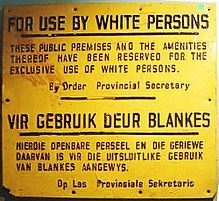 Signs that are displayed in areas affected by apartheidWikipediaNelson Mandela achieved things very little people achieved, changing and inspiring the whole world by never giving up and persevering through struggle. Mandela is a very humble person, he is a firm believer that he as well as the other people of South Africa played equal roles in ending apartheid. He also obtains the trait of forgiveness, being able to forgive others and move on for the better. Mandela serves as a great leader for South Africa, and sets an example for the world of the change that the nation has made: “‘There is nothing I fear more than waking up without a program that will help me bring a little happiness to those with no resources, those who are poor, illiterate, and ridden with terminal disease.’ Nelson Mandela” (Quotes by Nelson Mandela). In Mandela’s life, his goal is to help others, because it brings him joy; He’s a selfless person and cares deeply about his people. After his death in 2013, people around the world takes time out of their life to thank him for what he has done for the world: “Every year on July 18th, people across the globe celebrate Nelson Mandela’s birthday and contributions to the world by spending 67 minutes — representing the 67 years he fought for human rights during his lifetime — making a difference in the lives of others” (How Nelson Mandela left a lasting Legacy to the World). Not many people have a day dedicated to thems, but because Mandela’s impact is so huge, millions of people in the world are thankful for the 67 years that he has sacrificed for the better of others. To me, Nelson Mandela is inspirational because he’s someone I can really learn from. The quality of selflessness is not a quality I possess, but a quality that I should have. Although I think about how others feel, I usually put myself first, thinking about if I need it, rather than will doing this benefit others more than me. It is important to me to think about others first when a scenario involves a decision, like having extra food, should I share it with others, or should I keep it to myself? I should always think of giving it to others that might’ve not had enough of it instead of giving it to myself simply for my enjoyment. I want to help others in my spare time by volunteering or donating things that I no longer need like clothes, canned foods, and lots of others. Although doing so might not change the world like he did, I would feel happy that I helped others, because not only am I changing someone’s life, I’m also improving as a human being. “Simply put, then, the key to heroism is a concern for other people in need—a concern to defend a moral cause, knowing there is a personal risk, done without expectation of reward.” (What Makes a Hero). Nelson Mandela never expected the Nobel Peace Prize, he never expected to be the first black president of South Africa; he took many risks to defend for black rights and it all paid off, and the world changed because of one man that had the passion to change the world, and inspire others.
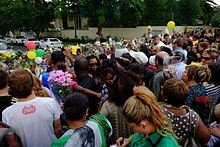 People pay respects to Mandela outside of his house in HoughtonWikipedia
Works Cited
By: Guest Blogger. “This Is How Nelson Mandela's Legacy Continues to Inspire the World.” ONE, ONE, 18 July 2017, www.one.org/international/blog/this-is-how-nelson-mandelas-legacy-continues-to-inspire-the-world/.
Hooper, Simon. “Nelson Mandela: Tireless Even in His 'Retirement' Years.” CNN, Cable News Network, 5 Dec. 2013, www.cnn.com/2013/12/05/world/africa/nelson-mandela-retirement-years/index.html.
“Inaugural Speech, Pretoria [Mandela]- 5/10/94.” Edited by Ali Dinar, Letter from a Birmingham Jail [King, Jr.], University of Pennsylvania, www.africa.upenn.edu/Articles_Gen/Inaugural_Speech_17984.html.
Mathye, Lucky. “Nelson Mandela On Oprah Winfrey Show.” YouTube, YouTube, 13 Sept. 2013, www.youtube.com/watch?v=cMl1lBPHp0o.
Meah, Asad. “50 Inspirational Nelson Mandela Quotes That Will Change Your Life.” AwakenTheGreatnessWithin, 28 July 2018, awakenthegreatnesswithin.com/50-inspirational-nelson-mandela-quotes-that-will-change-your-life/.
Mandela, Nelson – Facts. NobelPrize.org. Nobel Media AB 2019. Mon. 21 Jan 2019. https://www.nobelprize.org/prizes/peace/1993/mandela/facts/
“The Nobel Peace Prize 1993.” Nobelprize.org, www.nobelprize.org/prizes/peace/1993/mandela/facts/.
Zimbardo, Philip. “What Makes a Hero?” Greater Good Magazine, 18 Jan. 2011, greatergood.berkeley.edu/article/item/what_makes_a_hero.
Page created on 2/13/2019 4:52:46 AM
Last edited 2/15/2019 4:25:07 AM