REPRINTED WITH PERMISSION FROM THE CHRISTIAN SCIENCE MONITOR
Some research estimates that the Nepalbhasa language could be lost in 30 to 40 years. The Callijatra team hosts calligraphy workshops most Saturdays across Kathmandu Valley to preserve and promote Nepalbhasa and its writing systems.
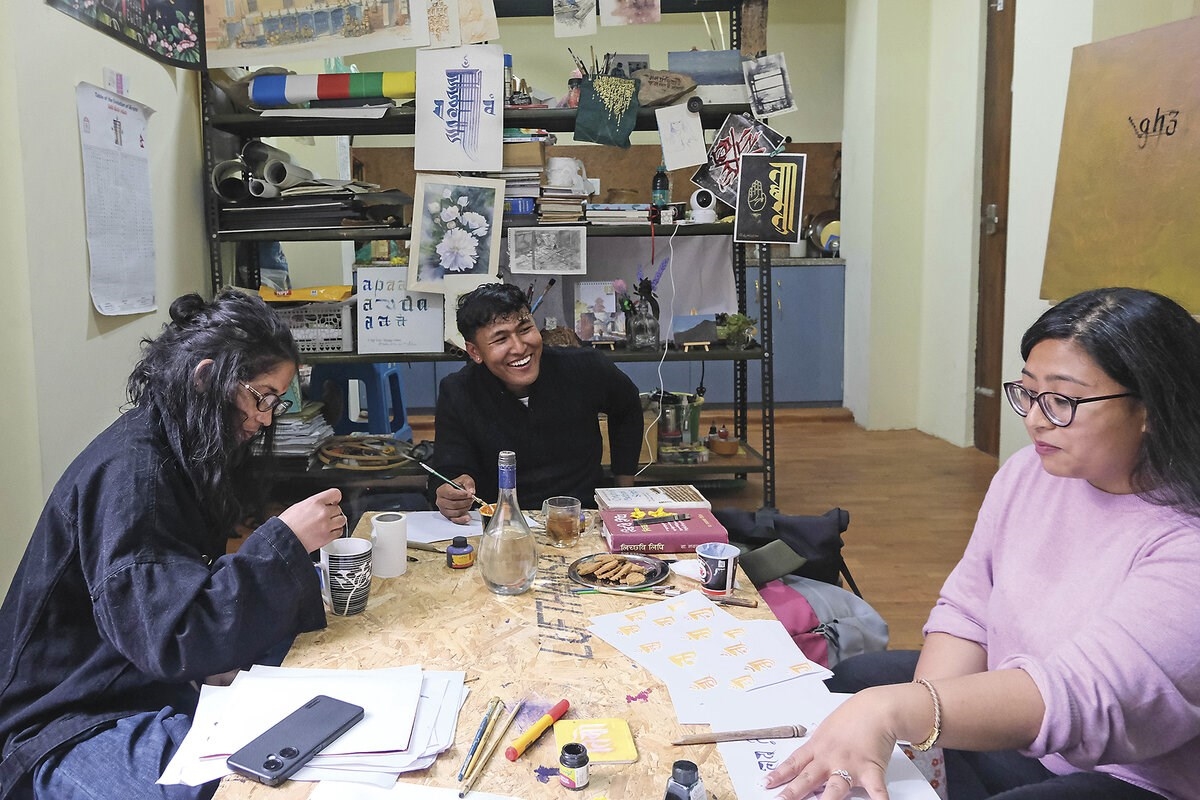 From left, Seema Gautam, Ejen Maharjan, and Lalima Shrestha participate in a calligraphy demonstration at Studio Nilo. Zinara Rathnayake
| Kathmandu, Nepal
As a schoolchild in Kathmandu, Ejen Maharjan watched in awe while his friend glided his pen in perfect curves to create ornate calligraphy in Nepalbhasa, the historical language of their people, the Newars. The friend was drawing Ranjana Lipi, which translates to “delightful script.”
“I didn’t even know how to write my name in Ranjana Lipi,” Mr. Maharjan recalls. “That hit me very hard.”
Today, the 23-year-old proudly dips his bamboo pen, called chosa, in blue ink to write beautiful, flowing Ranjana Lipi calligraphy, drawing thick strokes and intricate loops on paper. Mr. Maharjan is part of a group of calligraphy enthusiasts who are preserving and promoting Nepalbhasa and its writing systems across Kathmandu Valley, Nepal’s capital region in the Himalayan foothills.
Mr. Maharjan hones his skills at Studio Nilo, an art and calligraphy workshop in Patan, an ancient city-state in the valley. Outside, exposed-brick buildings with elaborate wooden windows line the narrow streets that wrap around central courtyards. Residents come there to nap, chat, sip tea, and play ceremonial drums.
Mr. Maharjan learned to write Ranjana Lipi from Callijatra, a Kathmandu-based organization that celebrates once-forgotten writing systems from across Nepal.
Callijatra was founded in 2017 by typeface designer Ananda Maharjan and local politician Sunita Dangol, who both studied at Nepal Lipi Guthi, a decades-old epigraphy institute. The two set up calligraphy workshops to increase awareness of Ranjana Lipi.
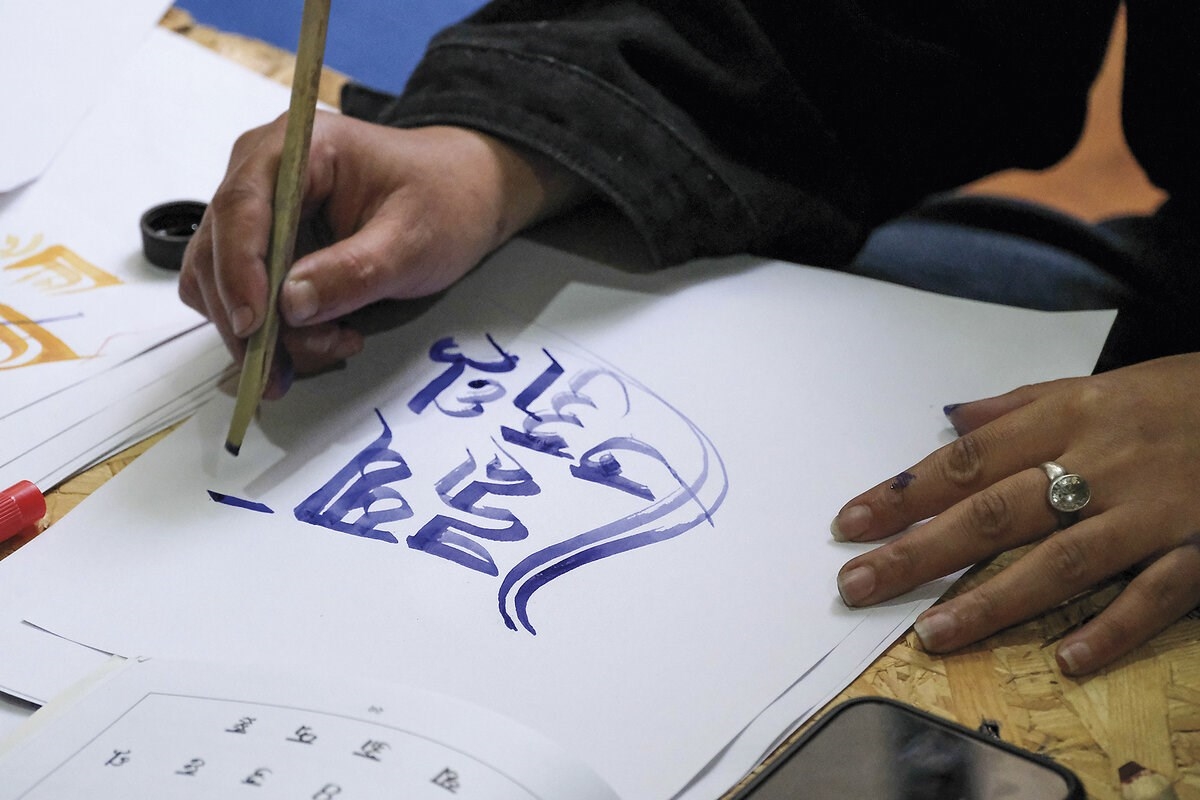 Zinara RathnayakeSeema Gautam practices Prachalit Lipi calligraphy, an ancient script used to write the Nepalbhasa language, at Studio Nilo in Patan, Nepal.
“They had realized that it should be promoted not just in a classroom, but all over the country,” says Callijatra’s vice president, Lalima Shrestha, who was part of the first workshop.
The Newars are the earliest inhabitants of Kathmandu Valley. Some anthropologists tie the Newars’ origins to the Kirat dynasty, which settled here around 7th century B.C. The Newars have used different alphabetic writing systems, including Ranjana Lipi.
While Nepalbhasa was widely adopted in literature and royal courts by the Malla kings from the 13th century, the Gorkha kings who conquered the valley and unified Nepal as one country in 1769 gradually eliminated the language. The Rana family, who ruled Nepal from 1846 to 1951, banned its use, imprisoning and expelling those who wrote and spoke the language.
Later, the state’s “one nation, one language” policy from 1961 to 1990 pushed for a national identity through Nepali, an Indo-Aryan language written in a script called Devanagari. Nepali became the dominant language in media, education, and government administration, while Devanagari replaced scripts once used by the Newars.
As Nepalbhasa was pushed to the margins, between 1952 and 1991, the percentage of the language’s speakers in the valley fell from 75% to 44%. Today, Newars make up only about 5% of Nepal’s population, and UNESCO classifies Nepalbhasa as “definitely endangered,” which means that young children no longer learn it as their mother tongue. Some research estimates that Nepalbhasa could be lost in 30 to 40 years.
Ms. Shrestha first came across a photo of Ranjana Lipi when she was age 14, during a social studies class. She asked her father to teach her the script, but he didn’t know it. Years later, still determined and enthusiastic to learn more about her heritage, Ms. Shrestha joined Callijatra’s workshop and eventually became part of the group. Callijatra’s team now volunteers to host workshops most Saturdays across Kathmandu Valley.
As many ancient books and other literary documents are written in Ranjana Lipi, knowing how to read this script is crucial to understanding Nepal’s history, religion, and artistic traditions.
Mr. Maharjan, who attended his first calligraphy workshop online during the COVID-19 pandemic, now uses every opportunity to teach others. When he can’t find a calligraphy pen, he uses a pencil. “Our generation is now aware of [Ranjana Lipi’s] value, and we need to teach it to children, so we can preserve our language,” he says.
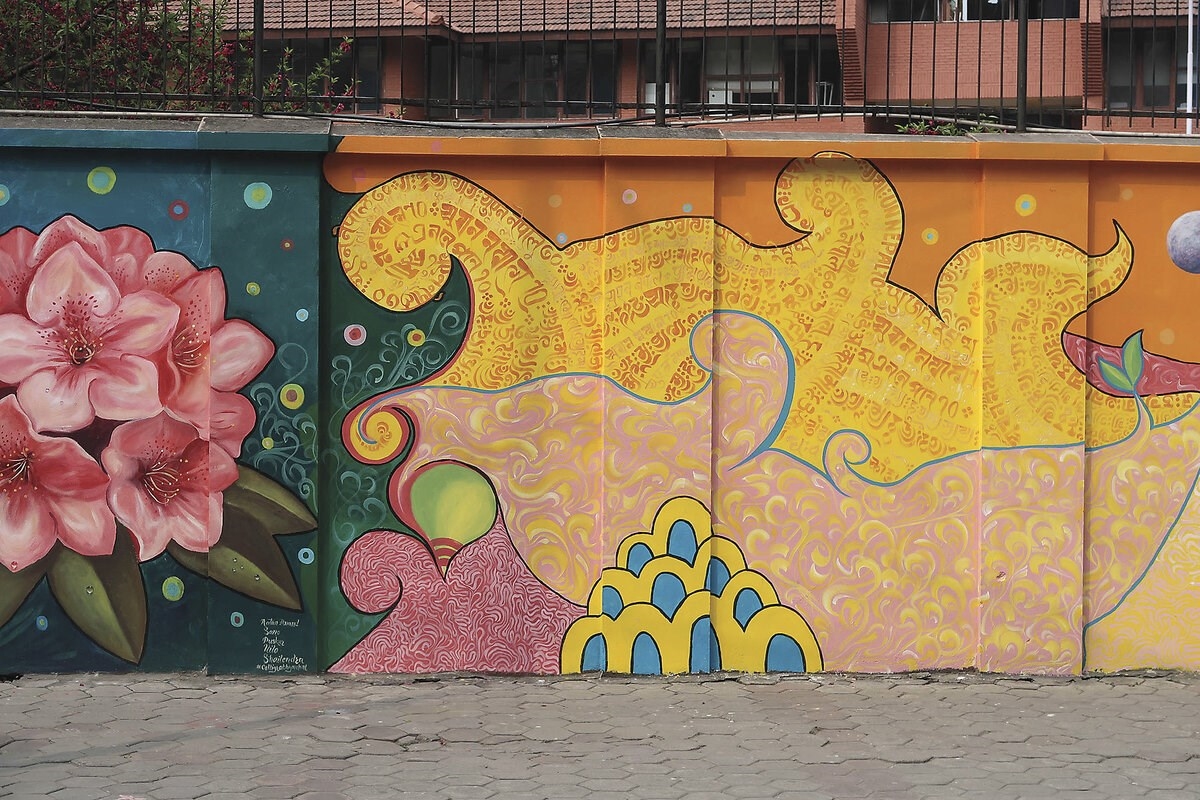 Zinara RathnayakeA mural in Kathmandu features calligraphy in several scripts.
Since Callijatra’s first workshop nine years ago, appreciation has been growing for Nepalbhasa and its scripts.
Young people such as Mr. Maharjan are driving this change, explains computer engineer Suyogya Ratna Tamrakar, one of Callijatra’s founding members. “They ask questions and want to learn about our culture,” he says.
“Calligraphy is a good medium to let them learn and know about what’s theirs,” Mr. Tamrakar adds. “Because it’s not just writing. It feels like you’re meditating. At workshops, schoolkids come and ask, ‘Please write my name in this style.’”
Bringing back the joy of old scripts through calligraphy has also created opportunities for those working in creative fields. Tattoo artists and jewelers incorporate the scripts in their designs, Ms. Shrestha explains while wearing a gold-plated ring with Ranjana Lipi motifs. Graphic designers in Kathmandu are increasingly using Kutakshar, a monogram of Ranjana Lipi in which several characters are interwoven, making it difficult to read. It was mainly used to write religious texts and mantras.
Those outside the Newar community are also drawn to the calligraphy workshops.
Studio Nilo co-founder Seema Gautam hails from Eastern Rukum, a mountain district 14 hours from Kathmandu, and was born and brought up in neighboring India. “When I do calligraphy in Ranjana, I feel like Devi [a Hindu goddess],” says Ms. Gautam. “They say it’s the second-most beautiful script in the world [after Chinese].”
Beyond calligraphy, Mr. Tamrakar and another team member have developed a mobile app. With more than 75,000 downloads, it translates Nepali writing into scripts such as Ranjana Lipi.
Callijatra’s efforts are part of a larger movement to reclaim and revive Nepalbhasa. After years of advocacy, the World Newah Organization helped get Nepalbhasa added to Google Translate in 2024. Ms. Shrestha is the general secretary at WNO, a U.S.-registered nonprofit.
Local governments are taking notice, too. In 2021, Kathmandu reintroduced Nepalbhasa as a mandatory subject in schools from first to eighth grades.
Ms. Shrestha looks forward to every Callijatra workshop.
“Our culture is so rich,” she says, explaining that she now speaks Nepalbhasa with her grandparents.
“The innovations that are happening in the West now were already there in our civilizations, but if you don’t know how to read what our ancestors have given us, how can we understand their knowledge?”
Page created on 5/7/2026 10:04:01 AM
Last edited 5/7/2026 10:14:43 AM