REPRINTED WITH PERMISSION FROM THE CHRISTIAN SCIENCE MONITOR
The Patriotic Citizen Initiatives shelter gives male migrants a place to stay when they are deported back to Nigeria. It also helps them rebuild their lives at home. “There were shelters for females,” the shelter’s founder says, “but nobody was talking about shelters for young men.”
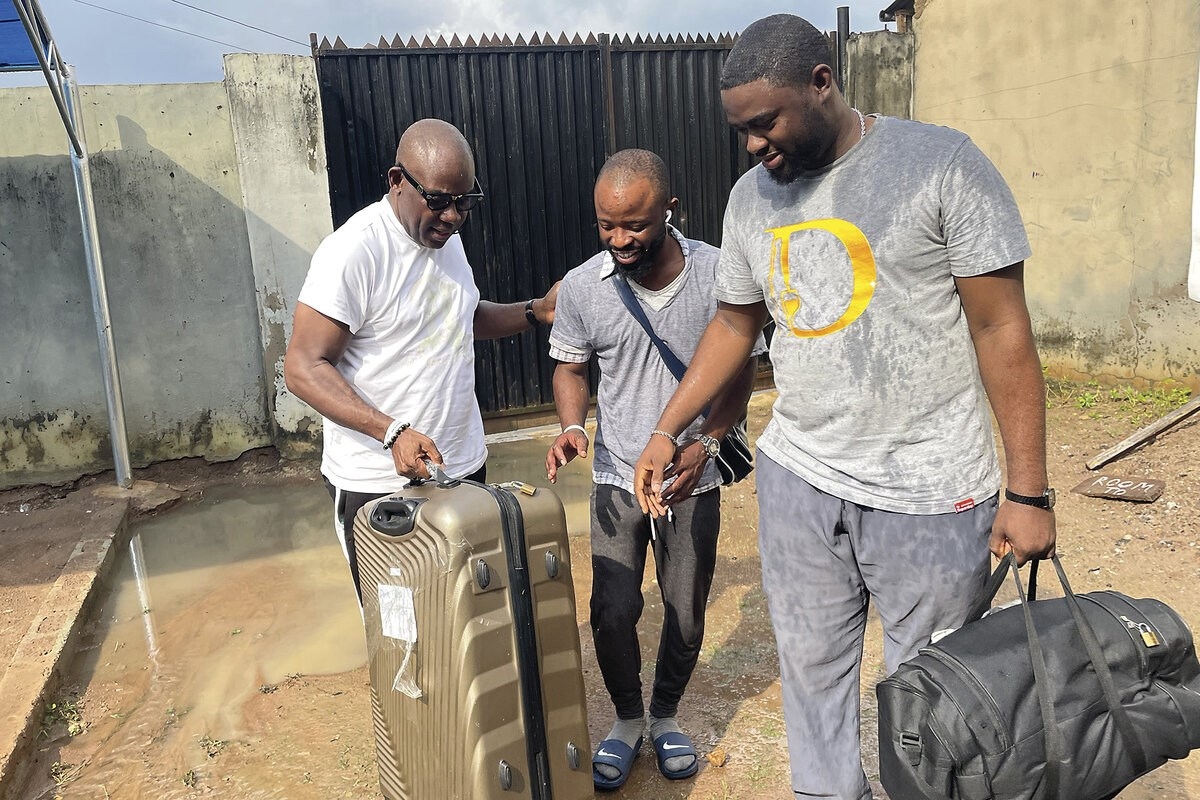 Osita Osemene, the founder of Patriotic Citizen Initiatives, left, and a staff member welcome returned migrant Fahad Nasir, at center. Violet Ikong
| Lagos, Nigeria
The heavy downpour outside the faded gray bungalow had just eased when Osita Osemene received a phone call from Fahad Nasir. Mr. Osemene stepped out to meet the young man, who had been repatriated back to Nigeria after spending three years in Tunisia, where he says he endured abuse and detention by security forces as a migrant without permanent legal status.
Mr. Nasir wasn’t ready to face his family or society yet. He needed a place to stay while he figured out how to restart his life.
Nigeria has dozens of government and nonprofit-run shelters that house female migrants who are repatriated after irregular migration – the practice of crossing borders outside legal channels. But the bungalow at which Mr. Nasir had just arrived is Nigeria’s first and only all-male shelter for returning migrants, launched in July 2021 by Mr. Osemene’s nonprofit, Patriotic Citizen Initiatives (PCI).
The organization works to restore the dignity of returned migrants from Nigeria and elsewhere, who often experience discrimination once they return home. Many Nigerians assume the migrants were deported for committing crimes.
“I was once a returnee like you, and I’ll share my story shortly,” Mr. Osemene says with a smile as he leads Mr. Nasir inside the facility’s lounge area, where five men – all returned migrants – welcome the young man with handshakes.
Located in Iyana Ipaja, a densely populated commercial suburb in Lagos state, the shelter accommodates 40 men at a time for three to eight months. They are housed in five dormitory-style rooms, each equipped with four sets of bunk beds and a bathroom.
“In Tunisia, I lived in the bush like an animal,” says Mr. Nasir, surveying his room. For the first time since leaving Nigeria, he has decent accommodations and is surrounded by people with stories similar to his.
Thousands of Nigerians, primarily young people, travel across the Sahara each year to transit countries such as Tunisia, Libya, and Morocco, hoping to eventually cross the Mediterranean to greener pastures in Europe. In the Sahel and Lake Chad region, Nigeria has the highest number of such migrants moving to Europe, a journey during which many face trafficking and other forms of abuse by security forces and armed rebels.
Mr. Osemene experienced such abuse firsthand. In 2004, as an unemployed young college graduate, he was deceived by friends into traveling to Libya to seek better opportunities. After he arrived, he was beaten and robbed by rebels.
“It was a horrible experience, and I promised God that if he took me back home, I would start a crusade to amplify the dangers of irregular migration,” he tells Mr. Nasir, minutes after the young man settles in.
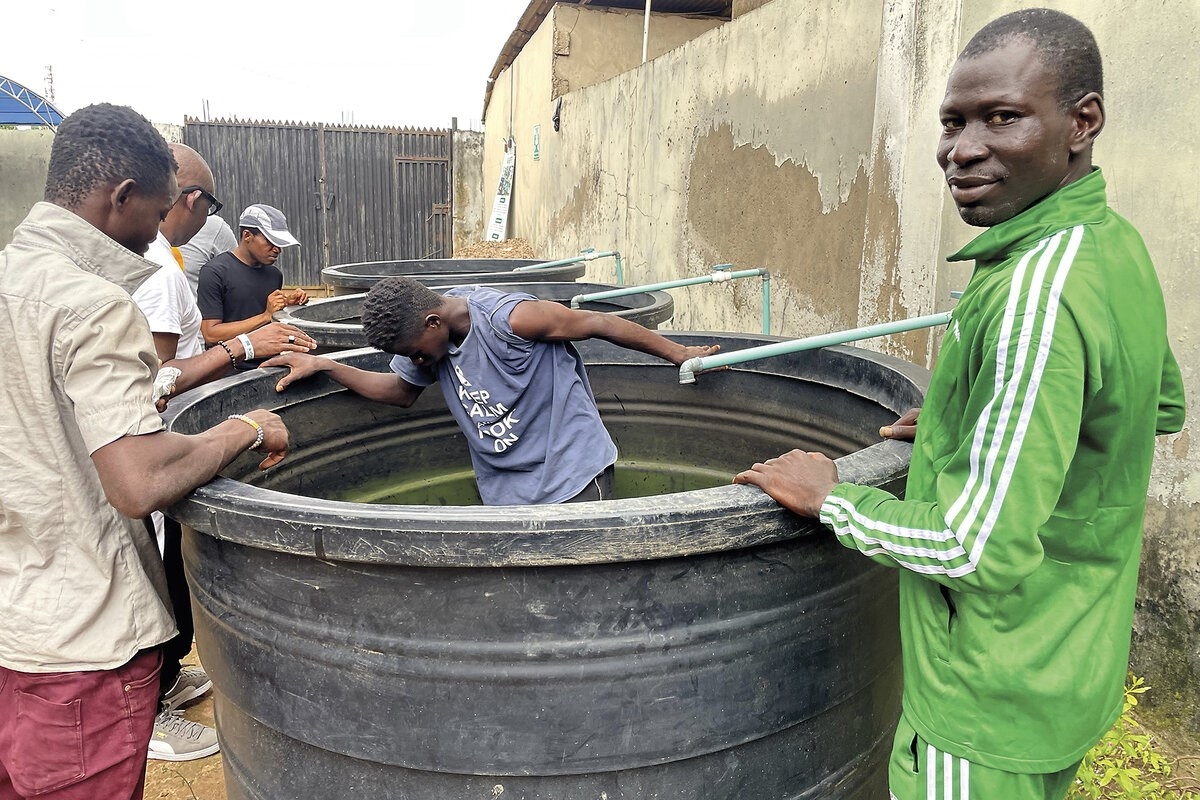 Violet IkongA migrant from Burkina Faso (at right) smiles as he joins residents in inspecting fish ponds at the Patriotic Citizen Initiatives shelter.
Mr. Osemene founded PCI to promote safe, regular migration while helping to rebuild the lives of Nigerians who had engaged in irregular migration and wound up deported home. He also began working with the International Organization for Migration and government agencies to train returned migrants on reintegration. That was when he noticed a disturbing trend.
“Male returnees were neglected,” he says. “There were shelters for females, but nobody was talking about shelters for young men, because men are perceived as people who are not vulnerable.”
When he spoke with male returnees, he found that many had survived detention, kidnapping, and even shootings. Some had turned to drugs in an effort to cope with their experiences.
“I said, ‘No, these people need a place,’” Mr. Osemene reveals, explaining why he built the shelter.
PCI operates a comprehensive reintegration program, which includes counselors.
“It wasn’t easy when I first arrived here,” says Promise Ehiogu, a shelter resident. “I kept having flashbacks of war and fleeing with just a loaf of bread and a bottle of water.”
He had just begun his master’s studies in Ukraine when Russia launched its full-scale invasion of the country in 2022. He traveled to Hungary, Germany, and finally Denmark, where he was denied asylum. He returned to Nigeria last March.
Now happy to share his story, Mr. Ehiogu is being trained to become self-sufficient. While most women’s shelters offer general training, such as how to make clothes and shoes, the PCI men’s shelter adopts a dual approach to entrepreneurship that covers agriculture and personal businesses of choice.
Returnees learn catfish farming and processing – a high-demand business. The shelter has three large ponds with catfish, which are sold to generate income and also are used for meals.
As a trainer in entrepreneurship development who is certified by the International Labor Organization, Mr. Osemene helps returnees to generate business ideas and launch startups. He connects returnees with professionals in their line of business for hands-on learning. Returnees also are supported with cash or tools to kick-start their businesses.
“I returned with no skill and didn’t know what to do with my life,” says Ridwan Segun, who had been trafficked from a Nigerian orphanage to Botswana as a 12-year-old in 2017, and recently returned home. “Through the training, which just ended for me, I am now an experienced barber with startup tools given to me.”
So far, the PCI shelter has housed more than 400 men. It remains the only all-male migrant shelter in Nigeria, which saw more than 11,000 of its citizens – most of them men – repatriated between 2023 and 2024. Mr. Osemene plans to build a bigger facility, but financing is a challenge. He runs the shelter with personal funds and occasional support from partner agencies.
For Mr. Nasir, the journey to recovery – and hope – has just begun. “If you have a place to put your head as a returned migrant, you’ll be able to think and plan how to pick up the pieces of your life,” he says. “This is a place for me to heal and get my life back.”
Page created on 1/28/2026 7:33:26 PM
Last edited 1/28/2026 7:53:05 PM