REPRINTED WITH PERMISSION FROM THE CHRISTIAN SCIENCE MONITOR
The Ogun River is a crucial waterway in southwestern Nigeria. The nonprofit Project Conserve Ogun River believes that training adults to protect it is vital, but that teaching children will yield results for generations to come.
 Unity High School students hold signs and copies of “The Loud Cry of Ogun River.” Ogar Monday
| Abeokuta, Nigeria
Ugonna Nkemjika is reading aloud from a storybook as a classroom of rapt children follows along. When she turns the page to an illustration of a river clogged with plastic bottles, a student’s hand shoots up.
“Yes, Blessing?” Ms. Nkemjika says to the girl.
“Is this our river?” the girl replies.
Ms. Nkemjika nods, and the room falls silent. The students, who attend Catholic Comprehensive High School on the outskirts of Abeokuta in Nigeria’s southwestern Ogun state, have crossed the Ogun River countless times. Some have fetched water from the river; others have watched fishers cast their nets into it. Yet for many of the students, this is the first time they are being asked to reckon with the peril their river is in – and how they can help.
Ms. Nkemjika is a volunteer with Project Conserve Ogun River (COR). “The Loud Cry of Ogun River,” the book open on the students’ desks, seeks to explain the river’s decline in terms children can absorb. Solomon Ekundayo, who founded Project COR and wrote the book, believes training adults to protect their natural resources is vital but that teaching children will yield results for generations to come.
“When children learn about conservation, they carry it home,” Mr. Ekundayo says. “They question their parents. They challenge what feels normal. Over time, that knowledge becomes culture.”
The Ogun is Nigeria’s fifth-longest river. It stretches nearly 480 kilometers (298 miles), beginning in Oyo state and running through the Ogun region before emptying into the Atlantic Ocean via the Lagos Lagoon. In addition to fishing, residents use the river for irrigating crops, drinking, and bathing.
As a child, Mr. Ekundayo regularly crossed the Ogun River with his mother, watching fishers ply their trade and kids play along its banks. But his understanding of conservation did not come until much later, after he began studying geology at Ahmadu Bello University and embarked on an externship involving freshwater conservation. As part of the program, supported by the National Geographic Society and The Nature Conservancy, he was asked to study a river system, and thought immediately of home.
But when he returned to the Ogun River, he barely recognized it. The water was darker and filled with plastic waste and untreated sewage. Fishing activity had plummeted, and in some areas, the stench alone kept people away.
“I saw more plastic than fish,” Mr. Ekundayo recalls.
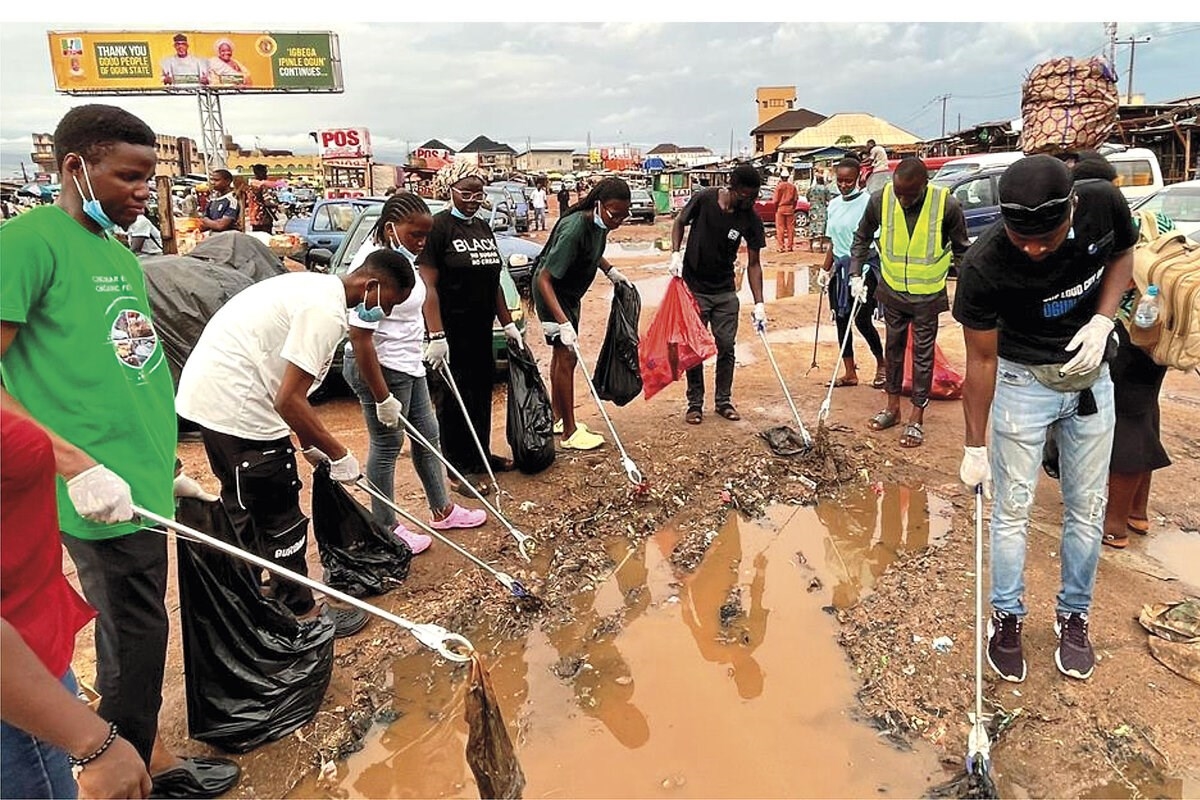 Ogar MondaySolomon Ekundayo (at far right) and volunteers conduct a cleanup in Abeokuta, Nigeria.
Studies show contaminants in the Ogun River often exceed safe limits, endangering the health of riverside communities. Aquatic life has been degraded, and the river’s natural ability to regulate flooding has been weakened.
“Rivers contaminated with untreated sewage and industrial waste become vectors for disease,” says M Isho Check, a public health expert based in Abuja. “This is worse for children.”
In late 2022, Mr. Ekundayo launched Project COR. From the outset, he thought that river cleanups alone would not be enough. The deeper challenge, he believed, was environmental literacy.
“People don’t connect dumping waste into the river with illness or flooding,” he says. “No one ever explained it to them in a way they can understand.”
So Mr. Ekundayo turned to storytelling. He drafted the text for “The Loud Cry of Ogun River” and worked with Project COR volunteers to illustrate it. Throughout the book, the river speaks.
“I used to breathe the fresh air of mother nature,” the river says in the expanded online version. “There is so much joy in being wanted.”
Child-friendly word puzzles reinforce key ideas, and concepts such as biodiversity are broken down into simple language. The book also weaves in Yoruba proverbs to pass conservation lessons on “in a familiar cultural way,” Mr. Ekundayo says. At the end, the book contains a pledge for students to sign, committing to environmental protection.
Saviour Iwezue, founder of Team Illuminate, an organization that is raising an army of young environmentalists across Nigeria, agrees with Project COR’s approach. She says many environmental campaigns fail because they overlook how behavior is formed.
“Children should not be seen only as future leaders, but as also capable of influencing what happens around them today,” Ms. Iwezue explains.
“If you want sustainable change, you change values,” she adds. “And values are most malleable in childhood.”
Teachers in Ogun state have noticed changes in students’ attitudes toward the river, thanks to Mr. Ekundayo’s book.
“Explaining [conservation and sustainability] used to be difficult because the children couldn’t easily relate,” says Ashade Adepeju, a teacher at Catholic Comprehensive High School. “Now they point at the illustrations and say, ‘That’s our bridge!’ or ‘My father fishes there!’”
Teenager Adebayo Firefunmi says he used to throw plastic pouches of water, commonly sold by Nigerian street vendors, into the river after drinking them. “Everyone did it,” he says. “But when I learned what plastic does to the river, I felt bad.”
Now, he says, he discards trash responsibly and reminds his friends about the “three Rs of reduce, reuse, and recycle,” when he sees them littering.
Project COR’s efforts include the wider community, too. The group’s volunteers have run campaigns to get residents to stop dumping waste into the river, and have set up informal dump sites that are easily accessible by shoppers at the popular riverside market. The group also has supported school environmental clubs and youth volunteer groups, many led by students who now organize cleanups themselves.
Mr. Ekundayo still crosses the Ogun River regularly. The fairly clear water he saw in his childhood hasn’t returned, but there is progress. On his most recent visit, he noticed something he hadn’t seen in years: fish swimming freely among the spindly reeds that hug the riverbank.
Page created on 2/22/2026 2:54:49 PM
Last edited 2/22/2026 3:08:39 PM