REPRINTED WITH PERMISSION FROM THE CHRISTIAN SCIENCE MONITOR
Israeli bombardment has destroyed many of the places that once housed Gaza’s books. The newly-opened Phoenix Library hopes to rekindle a culture of reading with a collection salvaged from the rubble.
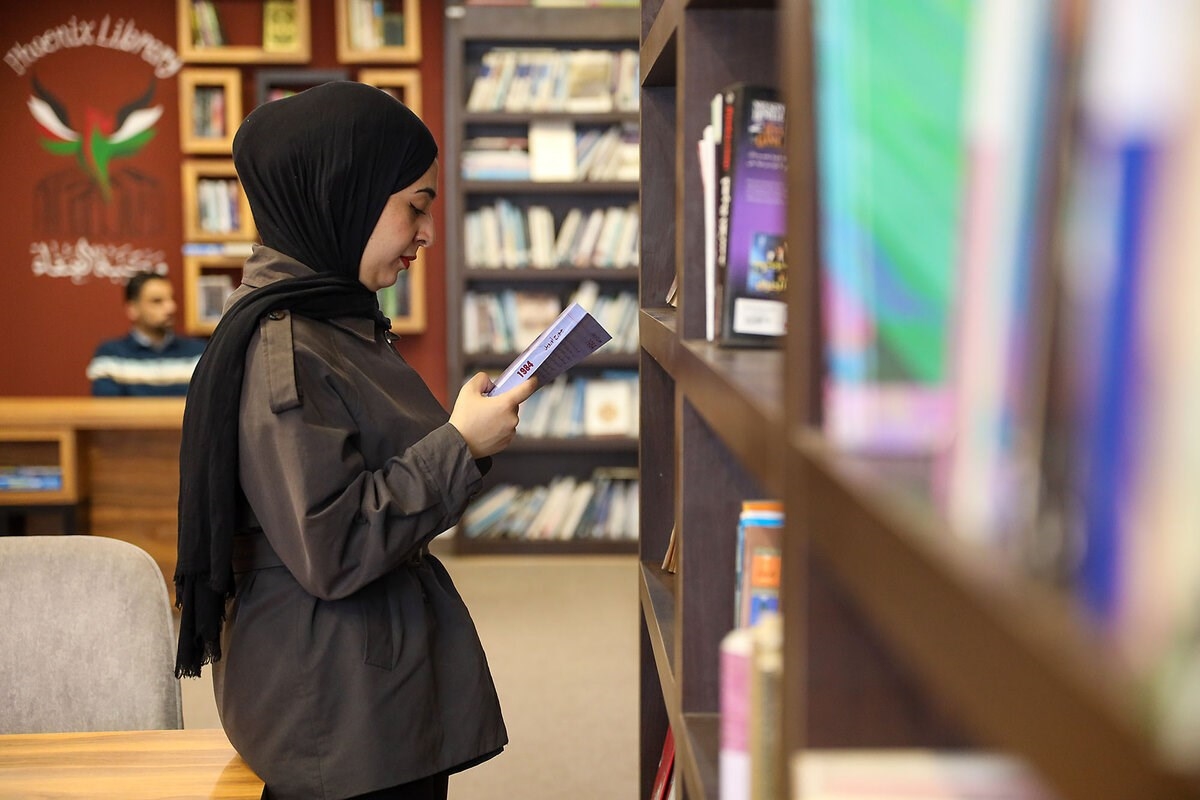 The Phoenix Library in Gaza City, Gaza Strip, aims to rekindle a love of reading among young Palestinians whose schools and libraries were destroyed by war, May 10, 2026.Ghada Abdulfattah
| Gaza City, Gaza Strip
On a Gaza City road strewn with rubble, beside a municipal park now crammed with makeshift tents, stands a small rented apartment that has become an oasis for rescued books.
The contrast that greets visitors of the Phoenix Library as they step off the damaged streets is immediate. The floors are freshly carpeted, the walls newly painted with murals of writers and snippets of verse. Patrons sit reading in plush chairs or scan the spines of some of the 6,000 books neatly arranged in shelves along the walls.
The library, named for the mythical bird reborn from ashes, emerged from Gaza’s ashes this April.
“We wanted to create a place where people could sit, read, drink coffee, discuss ideas, and feel human again,” says Omar Hamad, one of the library’s co-founders. “That itself is a form of resistance.”
Long before Mr. Hamad had a formal library, he was already a librarian.
A pharmacist from Beit Hanoun and a lifelong reader, Mr. Hamad spent years accumulating books. Before the war, friends frequently came by to borrow from his collection of about 400 titles, which ranged from rare volumes of Palestinian history to translated copies of Tolstoy and Shakespeare.
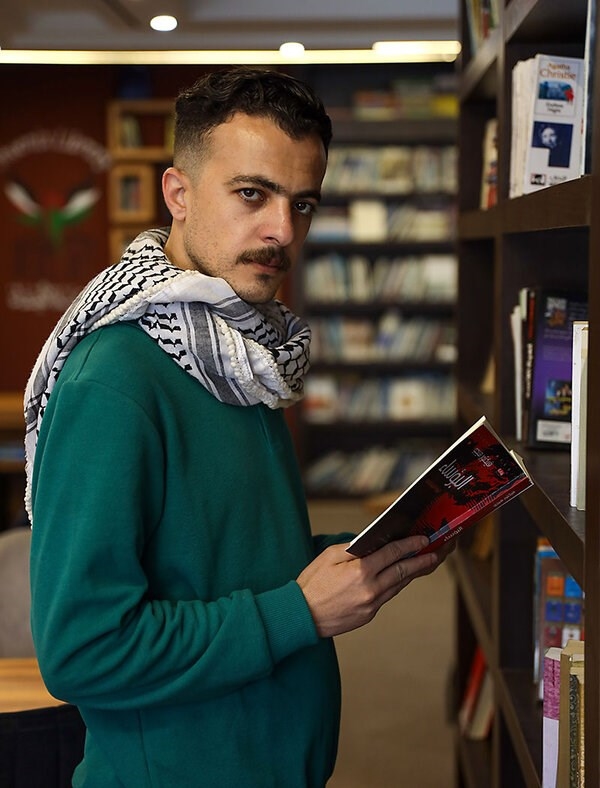 Ghada AbdulfattahOmar Hamad, co-founder of the Phoenix Library in Gaza City, Gaza Strip, skims titles in the library, May 10, 2026.
And so, when Israel invaded Gaza in October 2023, “the first thing I thought about was the books,” Mr. Hamad says.
When his family was forced to flee in the early days of the fighting, he took as many as he could. Over the next two years, roughly 120 of his most irreplaceable volumes traveled with him through a dozen more displacements, swaddled in blankets or stuffed in bags as he carried them from city to city. Mr. Hamad built shelves to display them inside the tents where he lived.
Meanwhile, during the war’s brief ceasefires, Mr. Hamad and his friend Ibrahim Massri, a writer and teacher, began venturing into damaged homes, universities, and abandoned libraries to rescue books from the wreckage.
The war eventually claimed dozens of libraries and archives. At the Islamic University of Gaza, Mr. Hamad found a storied library and its collection of a quarter million volumes reduced to a crater filled with twisted metal and torn pages. Over two days in early 2025, he carried off hundreds of still-intact books.
By then, Gaza residents were starving. At the library, “people were taking books to burn them for cooking fires,” he says. “You can’t blame them: Bread had become more important than anything else.”
Still, Mr. Hamad says it was “one of the hardest things” he witnessed during the war.
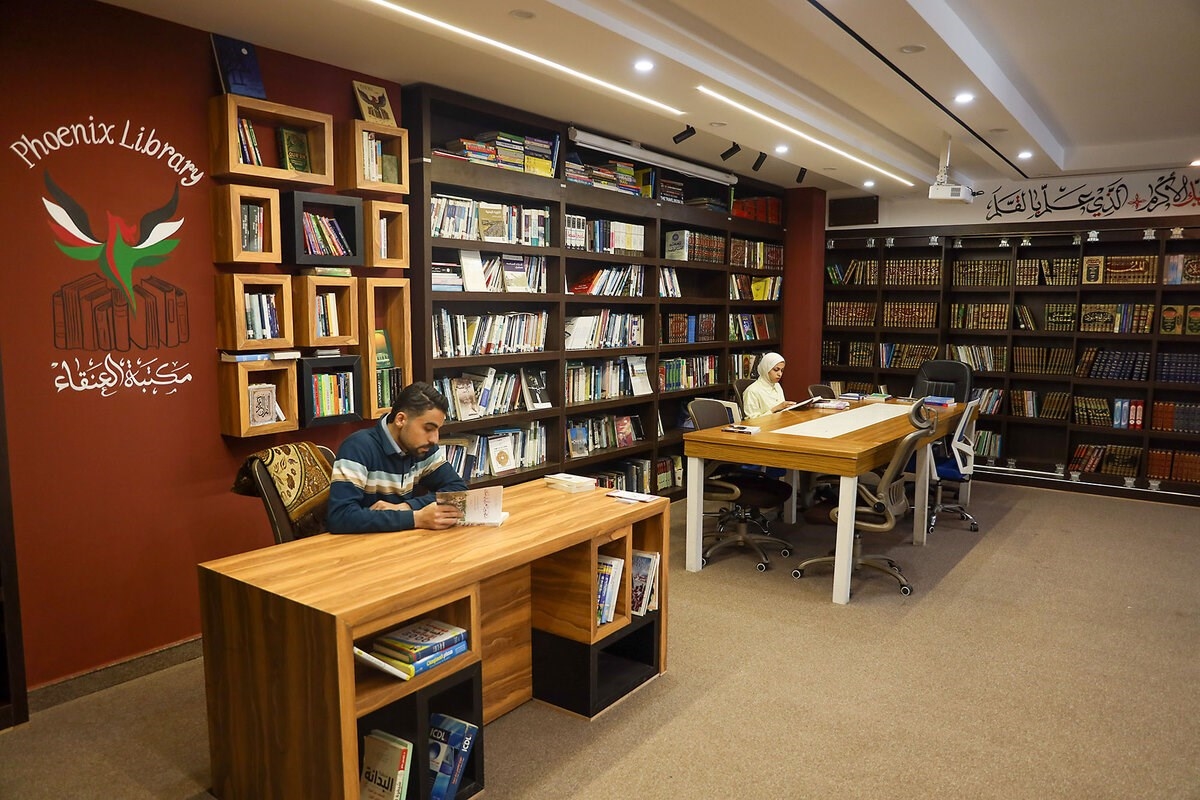 Ghada AbdulfattahPatrons use the reading room at the Phoenix Library in Gaza City, Gaza Strip, May 10, 2026.
At first, the itinerant collector didn’t have a plan for the books he rescued, only an instinct to save them. He was particularly concerned with texts related to Palestinian history, heritage, and literature.
The idea for a fixed library came after a ceasefire was declared in October 2025. Its architects were Mr. Hamad, Mr. Massri, and Mr. Hamad’s uncle Hussam Hamad, a scholar of human resources management.
To fund their idea, Mr. Hamad and Mr. Massri started a campaign on the crowdfunding site Chuffed. They wrote that they wished to create a home for “books carried through fire and dreams protected under bombs.”
The campaign raised more than $100,000, which the group used to rent a damaged apartment in Gaza City and rebuild the ruined space almost entirely from scratch. Materials were scarce and expensive due to restrictions on construction supplies entering Gaza.
As a result, the project took more than six months to complete. The three men and their team also did all of the electrical work, painting, carpentry, and shelving themselves.
“Under normal conditions, any library could be set up in two weeks,” Mr. Hamad says. “But we were building under siege.”
On one wall of the library is a painting of a phoenix in the four colors of the Palestinian flag – red, green, black, and white – with books beneath its wings.
Nearby, a Quranic verse is inscribed on the wall: “Read in the name of your Lord who created. He taught by the pen.”
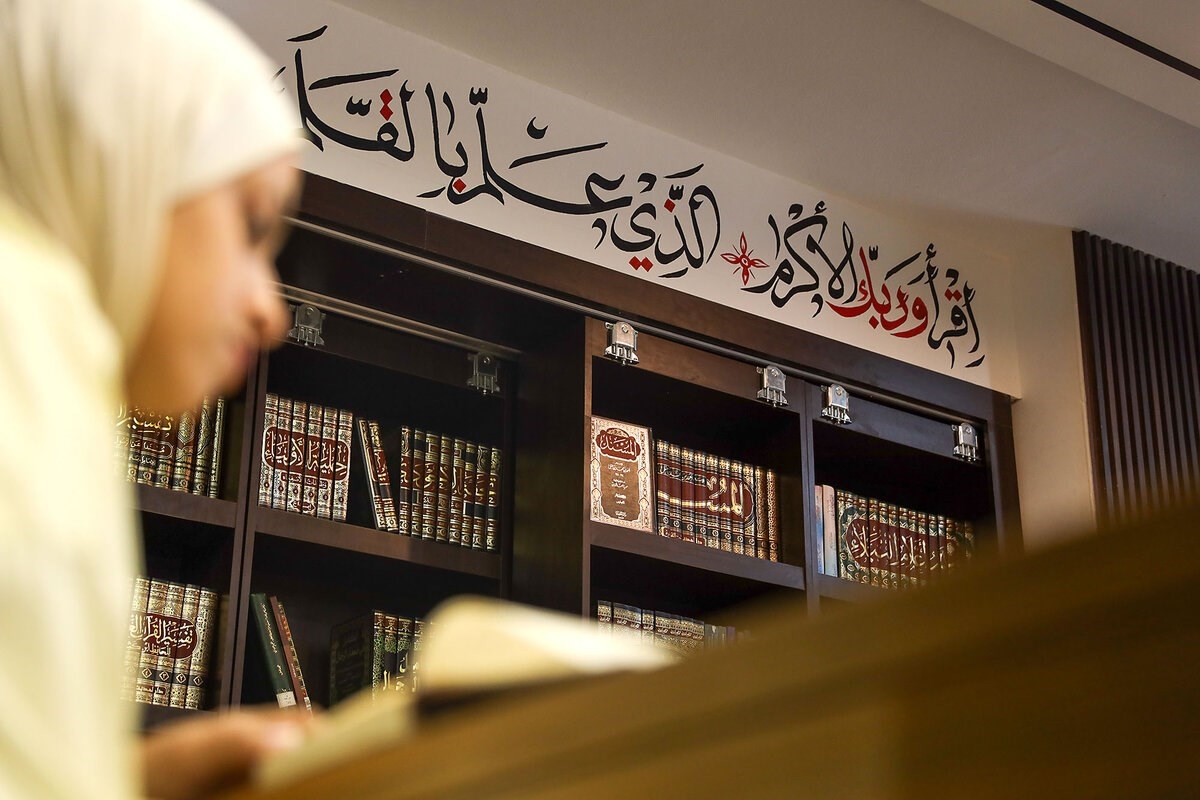 Ghada AbdulfattahA Quranic verse inscribed on a wall in the Phoenix Library, shown May 10, 2026, reminds patrons to “read in the name of your Lord who created. He taught by the pen.”
The library’s collection ranges widely. There are books on psychology, religion, economics, medicine, and Palestinian studies. In the literature section, copies of “Don Quixote,” “Animal Farm,” and “Love in the Time of Cholera” sit alongside the works of the great Palestinian writer Ghassan Kanafani, creating a sense of literature stitched together from many traditions and held in place by the act of reading, rather than the circumstances outside.
About 2,000 volumes on the shelves come from the personal collections of Palestinian academics, researchers, and students killed during the war.
Other titles were bought cheaply from improvised wartime secondhand markets, where displaced families and salvagers sold piles of books by weight.
Mr. Hamad says the library is especially important for children growing up during the war. Most have lost a year or more of their education, with 97% of Gaza’s schools damaged or destroyed by Israeli bombardment, and its education system “on the brink of collapse,” according to the United Nations.
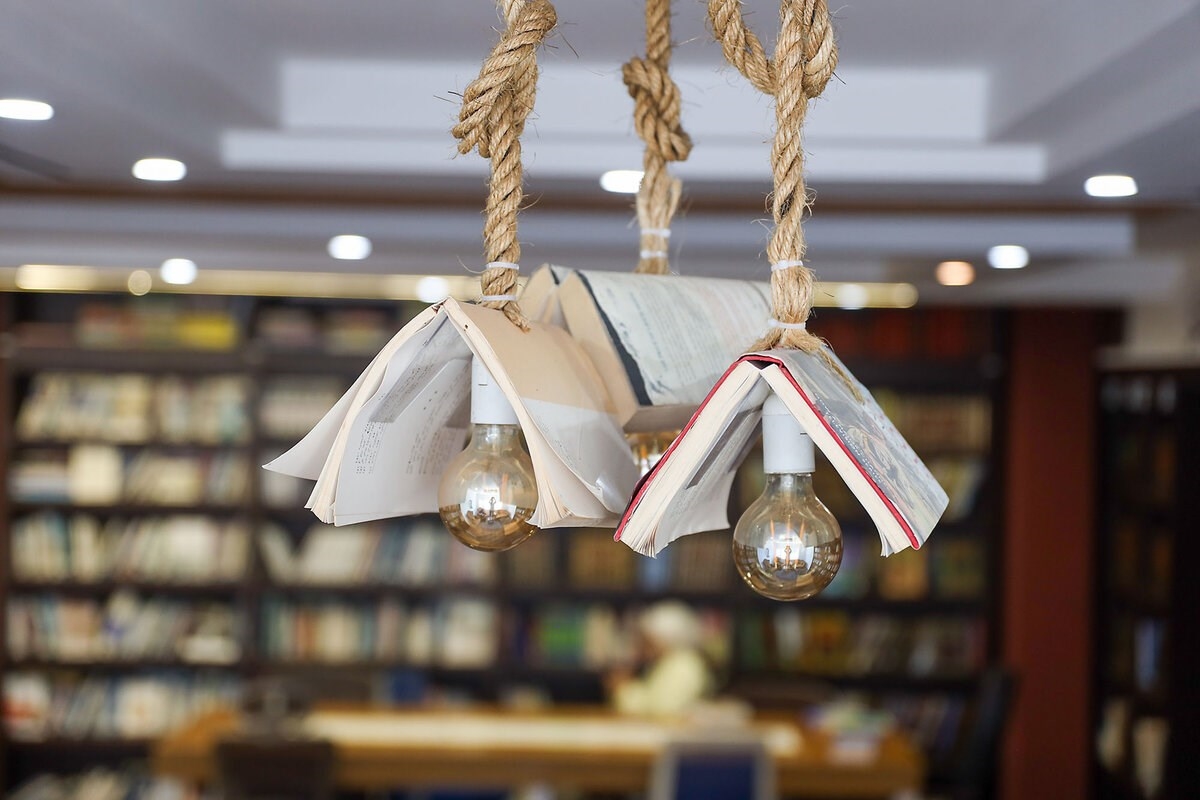 Ghada AbdulfattahGaza City's Phoenix Library, shown May 10, 2026, features many book-themed furnishings and decorations.
“A child who should be in fifth grade may barely know how to read now,” Mr. Hamad says. “Their whole environment has changed.”
The library already contains a collection of children’s books and intends to open a dedicated children’s activity room with reading sessions and educational programs.
In the meantime, visitors are already traveling long distances to spend time here.
Among them are sisters Nunez and Layan Abu Ras, engineering students from Gaza City, who visit multiple times a week.
“When we heard there was a library, we had to come,” says Nunez. “In the middle of all this destruction, finding a place full of books felt beautiful.”
During the war, both sisters found escape in reading. Layan says she finished around 50 novels, many of them mystery novels. Nunez, meanwhile, loved reading about psychology. Now, the library is expanding her tastes. She is currently making her way through “Crime and Punishment.”
“The smell of books, the atmosphere – it feels completely different from everything outside,” she says.
For Mr. Hamad, the return to reading after months focused only on survival has also been transformative.
“When I picked up a book again, I felt human,” he says. “Everything that had happened before suddenly felt far away.”
Outside the walls of his library, much of Gaza remains in ruins. But inside, as readers quietly turn pages, it feels to him that a cultural rebuilding has begun.
Page created on 5/26/2026 2:53:29 PM
Last edited 5/26/2026 3:04:20 PM