REPRINTED WITH PERMISSION FROM THE CHRISTIAN SCIENCE MONITOR
Instruments like violins and trombones can be hard for students to procure in the Republic of Congo, and classical music is often unfamiliar to Congolese audiences. But for a dedicated group of young musicians, their orchestra is a cherished opportunity of a lifetime.
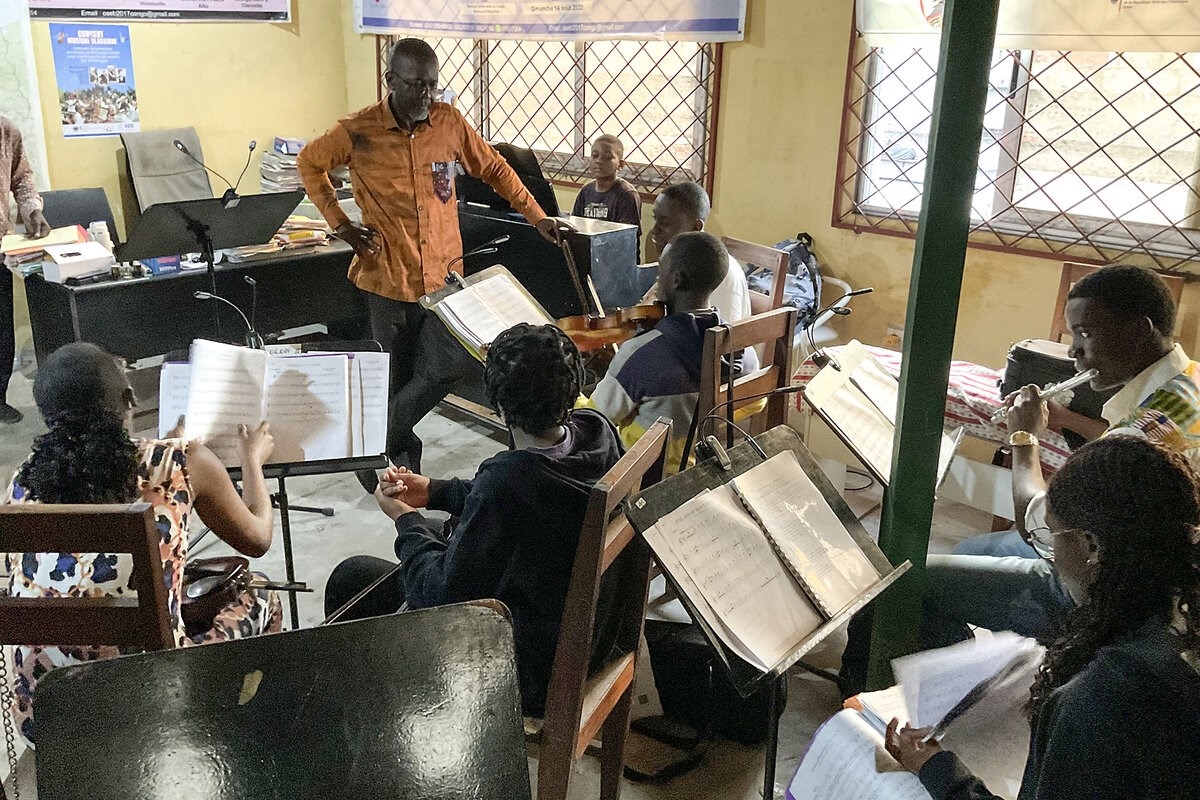 Tanguy Fouemina leads the Children’s Symphony Orchestra of Brazzaville during a practice.J.R. Patterson
| Brazzaville, Republic of Congo
On a sultry evening, the rehearsal for the Children’s Symphony Orchestra of Brazzaville begins. The space is cramped, the heat intense, and only two bare bulbs light the room. The young musicians twitch with nervous excitement as they clutch their violins and trombones. Finally, the conductor raises his baton, counts the preparatory beat, and solicits the opening notes of Vivaldi’s Concerto in D major.
Music permeates Congolese life. Fragments of rumba congolaise, a popular, danceable genre, drift from cars and shops in the capital, Brazzaville. Choral music is a pillar of church services. And traditional music, performed on handmade instruments, is common in the Republic of Congo’s hinterland. Yet classical music is often unfamiliar to the orchestra’s audiences.
Since the orchestra’s formation in 2018, co-founders Josias N’Gahata, Tanguy Fouemina, and Privat Babingui have introduced approximately 40 students, as well as audiences in Brazzaville, to a variety of Western classical music pieces. In addition to works by Vivaldi, Handel, Bach, and Tchaikovsky, the students perform original compositions by Mr. N’Gahata.
The orchestra members know this is about more than music; it is about joy – and discipline.
Holding his flute, 18-year-old Nissi Bokazolo says that he and his fellow musicians sometimes struggle to find the time to practice at home, but he feels a “great sense of responsibility when playing classical music.” Because instruments are hard to come by in his community in Brazzaville, not all students get the opportunity.
“It is a blessing to be in the orchestra,” says Vencianne Fouemina, a 12-year-old violinist who is also Mr. Fouemina’s daughter.
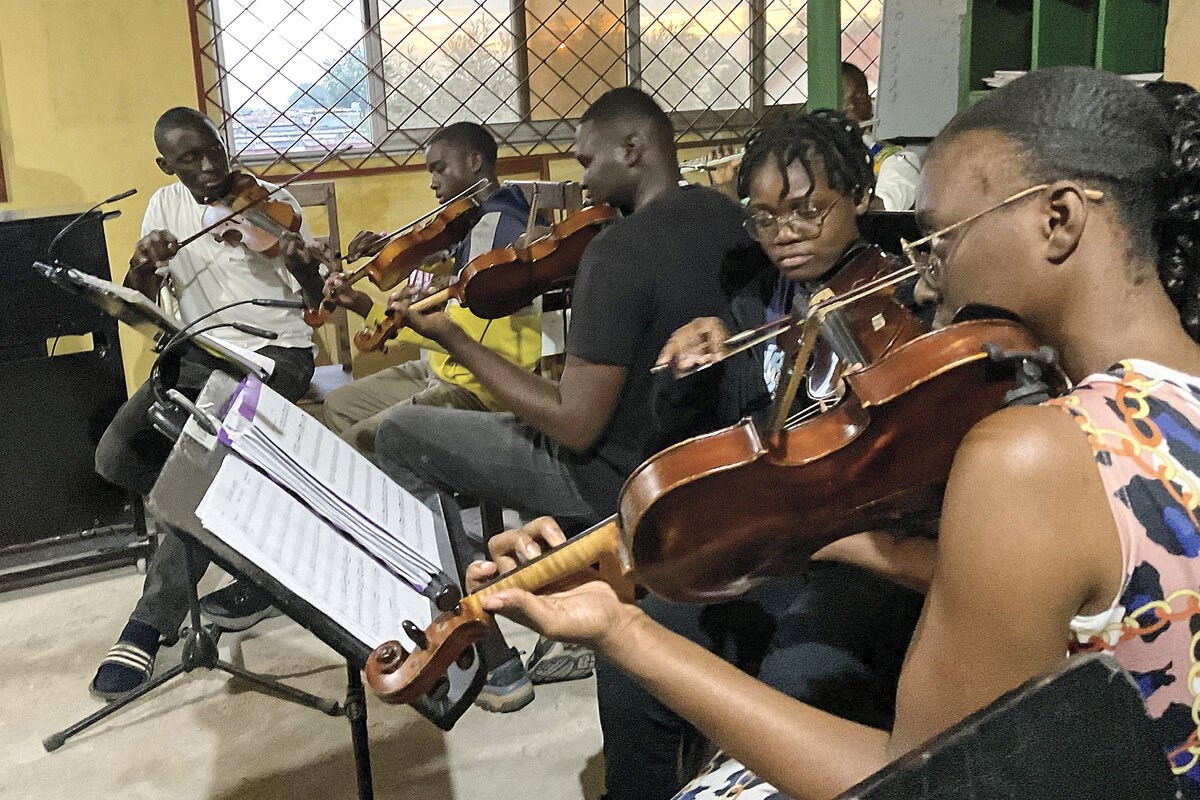 Tanguy Fouemina leads the Children’s Symphony Orchestra of Brazzaville during a practice.J.R. Patterson
The orchestra received its first instruments from Germany’s Goethe-Institut, and it continues to rely on national and international volunteers for financial support and music instruction.
“In a way, they are the perfect students,” says Ernst Bechert, a composer who provides master classes to the group through the Senior Expert Service (SES), a German program that sends specialized volunteers around the world. “They have true enthusiasm. It does seem like a release for them.”
Mr. Fouemina, an amateur pianist who works as a doctor at a local hospital, leads the orchestra during its regular weekend practice at a high school in southern Brazzaville. In mid-November, Monitor contributor J.R. Patterson attended a rehearsal, where he spoke with Mr. Fouemina. The interview has been edited for length and clarity.
Q: Can you tell me how the orchestra started?
Maestro Josias has a diploma in musical composition, and he had a vision of creating a school orchestra. So he wrote to the Goethe-Institut, [which] gave us the first instrument at the beginning. That’s why we often collaborate with the German Embassy here. [Musicians from Germany] come to work with us for two weeks each year.
Q: Would the children have access to this music if this orchestra didn’t exist? Is there another orchestra to join?
No. There is nothing for children just like this one.
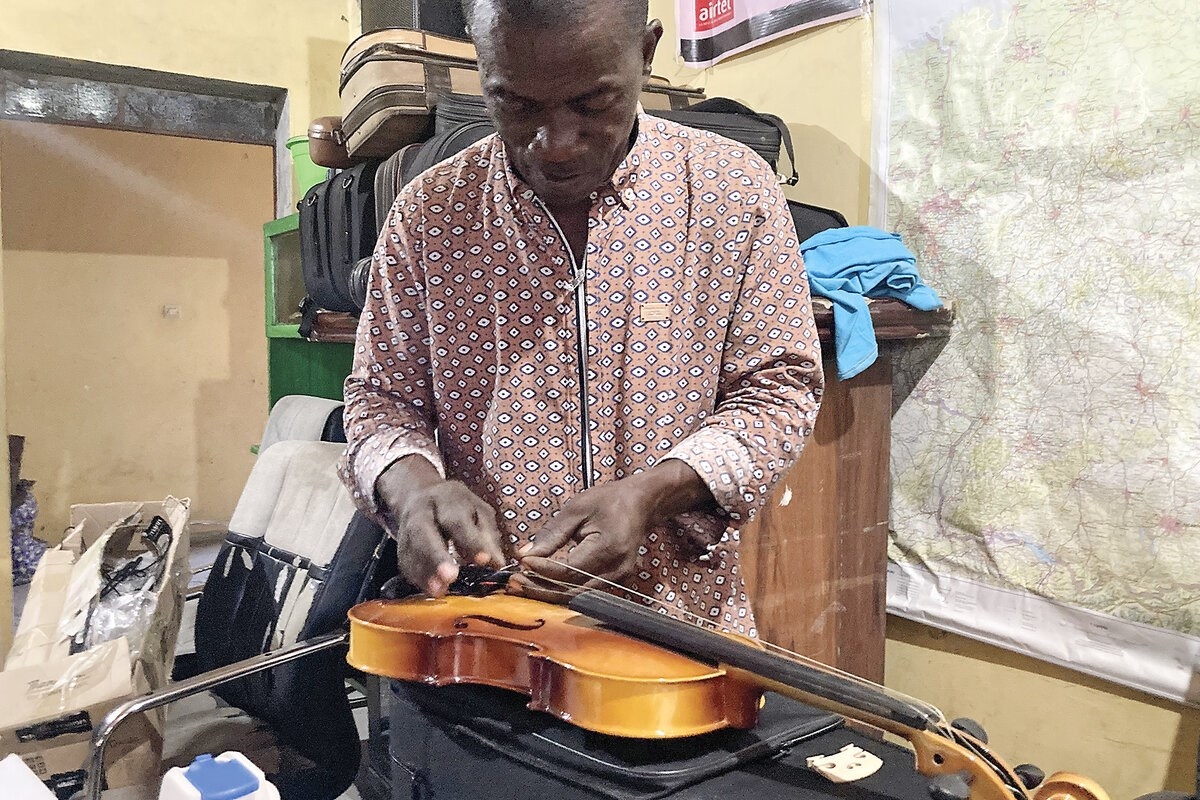 J.R. PattersonOrchestra co-founder Privat Babingui restrings a violin.
Q: How do you think this music benefits these children?
It’s a benefit for children because I think classical music makes children disciplined, and they have no time to do all the things which may be bad in society. An example: All our [musicians] will often be the best in their school.
Q: You play both Western classical music and rumba. What is important about playing both genres?
Classical music [covers] all the world, and rumba is our local music. So it’s important for the children to be able to play all music. It’s a platform [for expression].
Q: Is classical music a way of bringing the world – and different cultures – to Brazzaville?
Yes, different cultures. So, we play classical music, Chinese music, Russian music, German music.
Q: Have you played outside Brazzaville?
Outside of Brazzaville, not yet. One day, maybe. We have a project to go to Kinshasa [Democratic Republic of Congo], to Pointe-Noire.
Q: How do you start the students on the instruments? Does someone – a young child, for example – say, “I want to play bassoon”?
When children come, we give them the choice of instrument.
Q: People must see you in the hospital, or on the street, and they know that you’re involved with the orchestra. What do they say to you about the orchestra?
Sometimes they are surprised. Because those who see us the first time say, “Wow, in Congo, they are playing classical music!”
Q: What do you hope the orchestra gives the children, in their heart or in their head?
I think our children grow [through] the orchestra. So, I think they are in a good way. In our society, the children are not in a way which is [correct]. But our children, I think, are in a good way.
Q: What’s the impact on the players? Is there a feeling that there’s more knowledge to be had, that they can experience different places through the music?
I think it’s an opening to the world.
Page created on 1/28/2026 7:53:49 PM
Last edited 1/28/2026 8:05:55 PM