Born in Denver, Colorado, Ruth Stonehouse began performing as a dancer when she was a child. She eventually moved into film, joining the Essanay Film Manufacturing Company in Chicago, one of the most important early American film studios. She worked her way up from the company's front office to the screen and quickly became one of its leading players.
Stonehouse was an exceptionally busy actress. In 1915 alone, she appeared in at least 37 Essanay films. She worked in both comedy and drama and appeared alongside some of the most recognisable stars of the silent era. One surviving example is The Gilded Cage (1915), in which she played Marie, a young woman whose stepsister chooses wealth over love. The National Film Preservation Foundation describes Stonehouse's performance as nuanced and the film as an example of the concise storytelling of early cinema.
She was also fascinated by the production of films and wanted to be involved in both their artistic and practical sides. In a 1919 interview, she explained her ambition to become a director and producer and to work in the "business end" of filmmaking as well as the artistic end.
Her opportunity came when she moved to Universal in 1916. At a time when women directors were an important, if later largely forgotten, part of the American film industry, Stonehouse began writing and directing films in which she also starred.
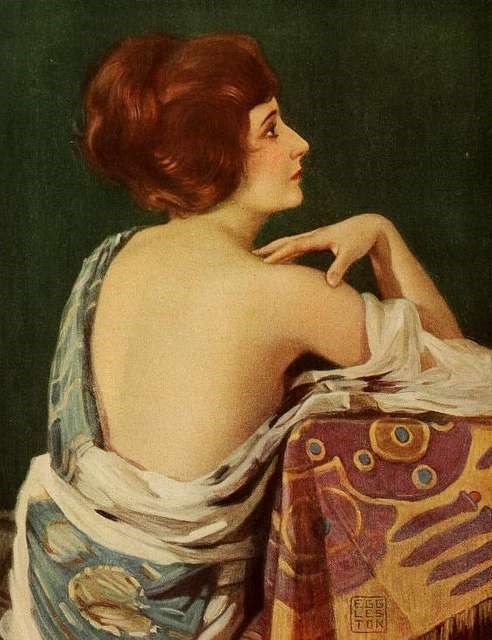 Ruth Stonehouse painted by Benjamin EgglestonShadowland, December 1922 via Picryl.comIn 1917, she developed a series of short comedies centred on a character called Mary Ann Kelly. Puppy Love, Daredevil Dan, A Walloping Time, The Winning Pair and other films gave Stonehouse the opportunity to work across several aspects of production. Her character could be compared with that of Mary Pickford, who perfected the screen persona of the comic, childlike picture of girlish femininity. Also, like Pickford, Stonehouse developed an impish character, at the same time creating ways to use this image to make a way into the film industry that would allow control over that image.
But Stonehouse was not simply the performer hired to play this role: she could help shape the story, direct the action and appear before the camera herself.
This was significant at a time when filmmaking was becoming an increasingly organised and commercially powerful industry. Women were active in many areas of early cinema, but their contributions were often poorly documented or subsequently overlooked. Stonehouse worked alongside other women directors at Universal, including Lois Weber, Ida May Park, Cleo Madison, Elsie Jane Wilson and Ruth Ann Baldwin.
Stonehouse's ambitions were not limited to light comedy. She directed A Limb of Satan, a 1917 short, and continued to work as both an actress and filmmaker. She also wrote the story for the 1925 film Rough Going, demonstrating her interest in storytelling beyond performance.
Her most important surviving directorial work is Rosalind at Redgate (1919), a Western made for Universal. Stonehouse directed the film and also played the title role. For many years, her directing career was difficult to assess because so little of her work survived. Rosalind at Redgate is now known to be the only one of her directorial films that survives, although only around 25 minutes of the original five-reel film remain.
The surviving material was restored from a nitrate print held by the Swedish Film Institute and presented at the 2019 Il Cinema Ritrovato festival in Bologna, where it was included in a programme celebrating films made a century earlier.
Stonehouse continued acting through the 1920s, appearing in films including The Master Mystery (1918–19), the famous serial starring Harry Houdini, in which she played Zita Dane. She also appeared in Parlor, Bedroom and Bath, Don't Call Me Little Girl, Poor Girls and The Devil's Cage. Her screen career ended in the late 1920s as the silent-film era gave way to talking pictures.
Stonehouse’s career shows that women were involved in early cinema not only as actresses, but also as writers and directors. She wanted to understand how films were made and to have a hand in making them.
Asked about her ambitions in a 1919 Motion Picture Magazine interview, Stonehouse was clear about where she wanted her career to lead: “We-ll, of course I do want to be a star… for a while… but eventually I want to be a directress, a producer; I want to be in the business end of it, that is, at the same time, the artistic end of it.”
Sadly, much of her work has been lost, but her career reveals an ambitious woman who took every opportunity to move beyond the role of actress and successfully establish herself as a filmmaker.
(Film Preservation Foundation)
Page created on 8/20/2026 9:32:07 AM
Last edited 8/26/2026 8:14:18 AM