REPRINTED WITH PERMISSION FROM THE CHRISTIAN SCIENCE MONITOR
Self-taught portraitist Seydou Keïta introduced “the African gaze” during a time of transition for the continent. A catalog and two exhibits celebrate his artistry.
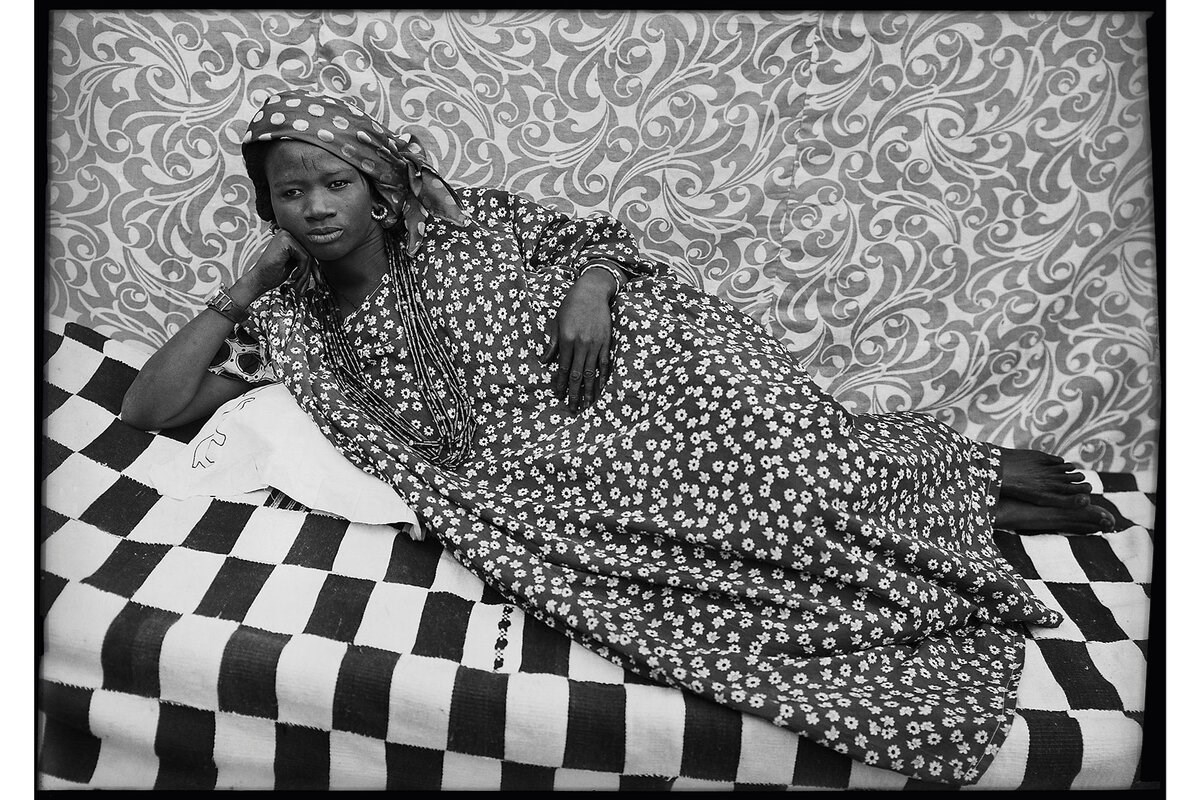 A woman reclines before arabesques of a fabric backdrop in “Untitled,” by Seydou Keïta, 1953-57, printed crica 1994-2001. Gelatin silver prints from “Seydou Keïta: A Tactile Lens,” a catalog that accompanies an extensive exhibition of 275 works at the Brooklyn Museum. Courtesy of The Jean Pigozzi Collection of African Art And Danziger Gallery, NY. Skpeac/Seydou Keïta
April 16, 2026, 8:02 a.m. ET
The late Malian photographer Seydou Keïta has been likened to a griot, a storyteller who preserves the oral history of his ancestors. But he was also a master of the moment, capturing the epoch in which Africans shed colonial rule and glimpsed their future.
With his emphasis on depicting Africans the way they wished to be seen, Keïta showed a society emerging from European control. And when his portraits from the 1940s to the ’60s eventually made their way to the West, they also challenged the stereotyped images of Africans found in magazines such as National Geographic.
“For the first time, [Western] audiences could experience what I’ll call the African gaze, and it amounted to a visual revolution,” writes Howard French, an essayist in “Seydou Keïta: A Tactile Lens,” a catalog that accompanies an exhibition of the same name at the Brooklyn Museum in New York.
Keïta was “thoroughly imbued with the spirit of his time,” French adds. He portrayed Africans at a turning point between their colonial past and their independent future.
His work is considered on a par with that of famous Western studio portraitists such as Richard Avedon and Irving Penn. While they had access to the latest technology in the boom years after World War II, Keïta had none of those things. While Americans were buying Polaroid Land Cameras, people in colonial French West Africa did not typically see or own permanent images of themselves, let alone have the tools to take them.
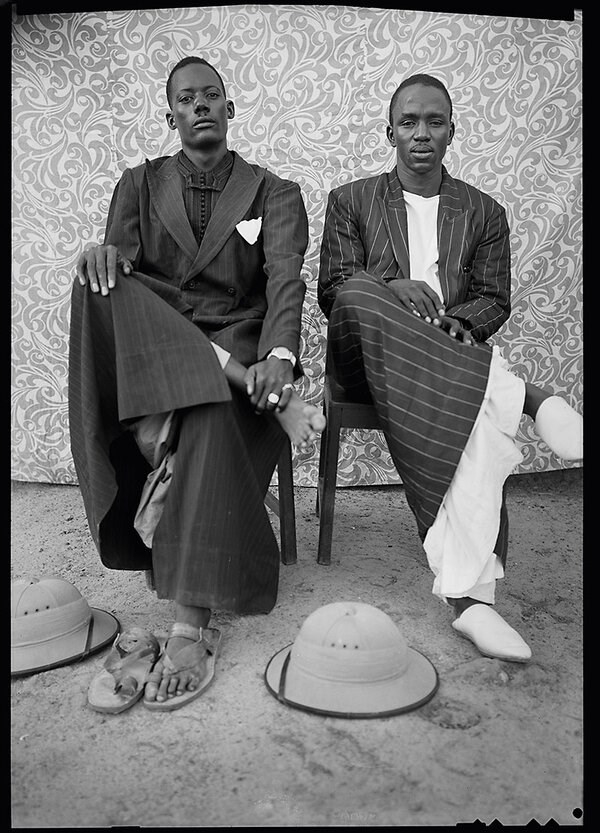 Courtesy of The Musee National Du Mali. © Skpeac/Seydou Keïta. Courtesy The Jean Pigozzi Collection of African Art And Danziger Gallery, NYTwo men and their hats fill “Untitled, 1956-57” by Seydou Keïta, printed circa 1994.
Enter Seydou Keïta. He was born in Bamako, Mali, in 1921, and, as the eldest son, became the chief breadwinner, working in his father’s trade of carpentry to support an extended family of 100 members. When Keïta was age 14, his uncle gave him a Kodak Brownie Flash camera. Making pictures became his passion.
In 1948, Keïta opened a portrait studio in the courtyard of his family compound. For the next 15 years, customers flocked to have their pictures taken. They wished to ensure their image for posterity, primping for the camera in their own finery or with props he provided such as watches, pens, radios, Western suits and ties, even a Vespa scooter.
Keïta was famous for his skill with such portraits. “The self-image fixed on paper – it started with Seydou,” as Kader Keïta, a family member, told exhibition curator Catherine E. McKinley. Customers came from all over West Africa, queuing up in Keïta’s courtyard to choose their poses and costumes from his samples. Keïta’s family members served them tea and bantered with them. It was a celebratory outing, often memorializing a wedding, engagement, or birth.
Keïta photographed all day and spent time at night in a darkroom making 5-by-7 prints that the sitters collected the next day.
What’s remarkable about these portraits is that Keïta, who was self-taught but a wizard when it came to lighting his subjects and arranging their poses, only clicked the shutter once – for reasons of economy. The portraits – shot outdoors in natural light since electricity was a luxury – are luminous. Skin glistens, fingernails shine.
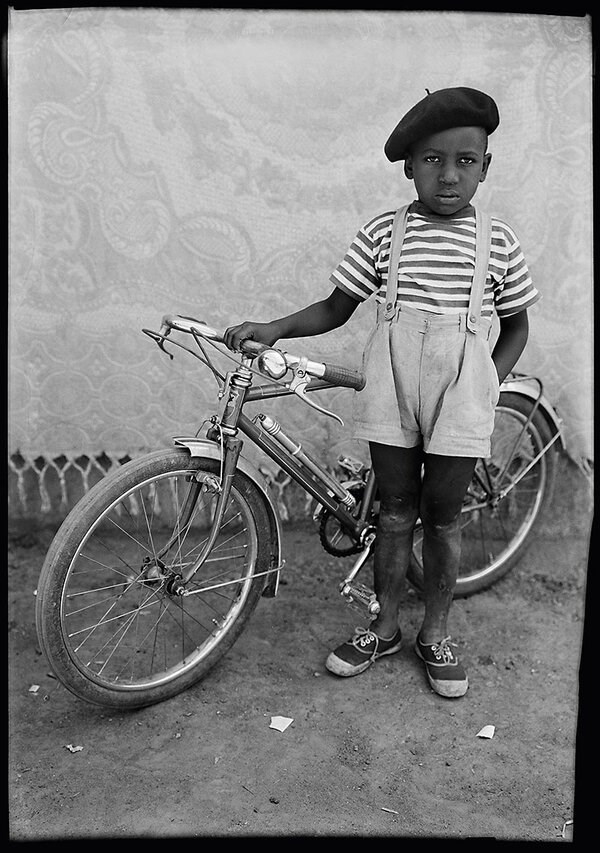 Courtesy of The Jean Pigozzi Collection of African Art And Danziger Gallery, NY. © Skpeac/Seydou KeïtaA boy and his bicycle appear in “Untitled, 1949-1951,” printed 1995.
The images were a collaboration between sitter and photographer, with Keïta fluffing garments and directing poses to maximize a commanding sculptural presence. Through their bold gazes, the subjects appear to leap out at the viewer, dignified, powerful, and alive.
Handwoven textiles used as backdrops are Keïta’s signature and recall African visual culture. (Keïta’s younger brothers were in charge of holding up the fabrics, including Keïta’s own fringed bedspread.) The patterned textiles add dynamism, density, and detail. (The use of patterned backdrops reappears in contemporary art, such as in Mickalene Thomas’ paintings and Kehinde Wiley’s portrait of President Barack Obama.)
A print of a woman in recumbent pose shows how Keïta actively staged his images to create an elegant aura. The woman reclines on a checkerboard fabric wearing a flowered gown and polka-dotted headscarf. Arabesques of a fabric backdrop surround her.
Despite Keïta’s status as a celebrated 20th-century African master, his discovery by the Western art world was almost by happenstance. Two of his portraits (attributed anonymously) caused a sensation in a 1991 group show of African art in New York. Collector Jean Pigozzi tracked down their Malian creator, who was then working as an auto mechanic.
Malian government officials forced Keïta to close his studio in 1963 and work for the state until he quit in 1977. After his “rediscovery,” collectors and museums printed his negatives using the latest technology. Seeing his negatives transformed into large formats and framed for the first time, he was thrilled. “I knew then that my work was really, really good,” he said shortly before his death in 2001. “The people in my photos looked so alive, almost as if they were standing right in front of me.”
Keïta’s images reflect both his clients’ aspirations toward a modern, urban identity and their reverence for still-potent cultural traditions. This extensive catalog shows, through the eyes of a premiere portrait photographer, a society in transition.
The exhibition “Seydou Keïta: A Tactile Lens” is on display at the Brooklyn Museum until May 17. Nine photographs by Keïta are also on view at New York’s Museum of Modern Art in a group show, “Ideas of Africa: Portraiture and Political Imagination,” through July 25.
Page created on 4/20/2026 1:50:28 PM
Last edited 4/20/2026 2:01:40 PM