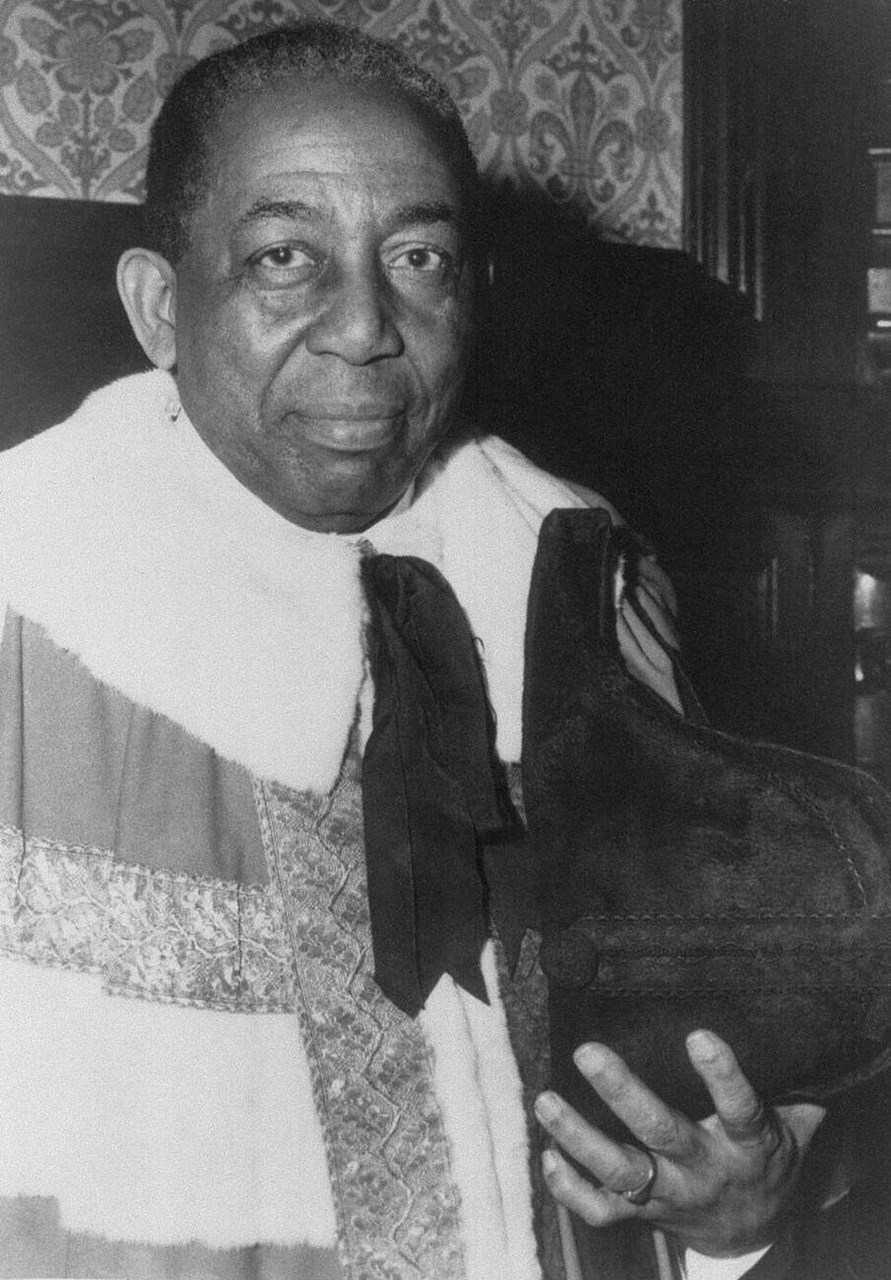
 Sir Learier Constantine, 67, is shown in his robes as he became the first black man in history to take a seat in British House of Lords in London. Lord Constantine, once one of the world's great cricket players, was high commissioner for Trinidad and Tobago in London from 1962 to 1964.Associated Press via Wikimedia Commons
When Learie Constantine was born in Diego Martin, Trinidad, in 1901, Trinidad was still part of the British Empire. Though slavery had been abolished throughout the Empire for some seventy years before Constantine was born, not much had shifted in terms of both systemic and social and cultural racism. Despite that, Constantine’s family fostered in him a fierce desire to bring about change and equality.
Born to cricketing star Lebrun Constantine, Learie was quick to follow in his father’s footsteps. He was an exceptionally gifted cricketer himself and was part of the West Indies test match team by the time he was twenty-one. “To say that he plays cricket,” said cricket correspondent Neville Cardus of Constantine, “is to say that a fish goes swimming.”[1] In 1928, Constantine joined Nelson Cricket Club in Lancashire and moved to the UK with his wife and daughter. Becoming the first West Indian to take a wicket in a test match and the first person to ever take five wickets in one inning, Constantine was soon hailed as one of the greatest to ever play the game and was widely celebrated in Britain as a sporting hero.
However, Constantine’s experience on and off the pitch vastly differed. Even as a sporting sensation, Learie could not escape the prejudicial attitudes of the time. By the 1930s he had taken an active role in the British Civil Rights organization the League of Coloured Peoples and began penning Cricket and I, an exploration of how racial attitudes and colonialism impacted the sport.
In the height of the Second World War, Learie was living in Liverpool in the UK working for the Ministry of Labour and National Service, where he oversaw the well being of factory workers from the West Indies and Africa. Following an influx of US service men, incidents of racism become more frequent. Having traveled from the US, where many spaces were still segregated, many of the servicemen began boycotting various businesses, making the lives of Black people increasingly difficult.
In 1943, in a moment that would arguably solidify the trajectory of his life as an advocate, Constantine and his family booked a four-night stay at the Imperial Hotel in Bloomsbury in London. Upon arrival, the family were told they would only be permitted to stay for the night, owing to their being Black. Constantine filed and won a groundbreaking case against the hotel group, which sparked Government action against racial discrimination.
The legal battle with Imperial Hotels emboldened Constantine in his pursuit of Civil Rights. In the early 1960s he took on the role of High Commissioner for Trinidad and Tobago in London, in which he helped navigate the changing politics of post-colonial Britain. By 1969, Constantine’s lifelong commitment to Civil Rights were formally recognized when he became the first Black peer in the House of Lords. He dedicated the rest of his political career to numerous social causes including racial equality, education, and worker’s rights. Constantine recognized the importance of intersectionality in matters of social justice, particularly economics, and made it his mission to ensure that everyone (particularly minority groups) was given access to quality education leading to better employment opportunities.
Sir Learie Constantine died on the 1st of July 1971, aged sixty-nine. Constantine was heavily featured in Trinidadian journalist and historian, C. L. R. James’ 1963 memoir on cricket Beyond a Boundary. In the book, James summed up Constantine’s outlook perfectly:
Many doors in England were open to him. That doors were closed to other West Indians seemed more important to him.[2]
Page created on 8/26/2026 4:36:31 PM
Last edited 8/26/2026 4:40:27 PM