Born July 9, 1956, in a San Francisco suburb, Tom Hanks certainly didn’t seem destined for fame. The son of an itinerant chef and a hospital worker, the middle child among four siblings, and coming from humble working-class origins, the young Hanks had his eyes set on the stars — literal stars. He wanted to be an astronaut. Hanks never imagined that he would become a star himself.
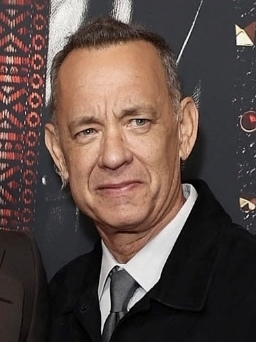 Tom Hanks at the Elvis Premiere 2022Eva Rinaldi from Abbotsford, Australia, CC BY-SA 2.0, via Wikimedia Commons
Hanks’s youth was marked by his fractured family life. Living primarily with his itinerant chef father, he rarely called one place home for long. “By the time I was ten years old, I had a mother and two stepmothers, I’d lived in ten different houses in five different cities,” Hanks said in Tom Hanks: Superstar by Barbara Kramer. While Hanks later credited this constant upheaval with making him “flexible,” it also made him a lonely child. There was little opportunity to build lasting friendships as his family moved from place to place. Beginning in middle school, however, his family settled in Oakland, California. Almost as if making up for lost time, Hanks threw himself into everything he could: playing soccer, running track, and joining a church group. “I was 14 and needed something very badly,” Hanks explained. “Not just something to believe in, not just some sort of faith. I needed a brand of acceptance that would combat the loneliness I had felt all the way up to then.” Soon enough, one of his friends was roping him into his high school’s drama class.
 Tom Hanks after his first Academy Award nomination, 1989Photo by Alan Light, CC BY 2.0, via Wikimedia CommonsHanks took to acting easily. Though shy by nature, he was also a class clown, and the stage gave him an outlet for his energy and creativity. His first role was a bus driver in the play Night of the Iguana; by his senior year, his school’s drama department had awarded him an “Oscar” for Best Actor. More than two decades later, Hanks would thank his high school drama teacher, Rawley Farnsworth, while accepting his first real Oscar. At the time, however, he had little interest in pursuing acting professionally. After graduating, he attended Chabot Community College, majoring — as he later joked — in “waiting for something to conk me on the head and say, ‘This is the direction you want to go in.’” That moment arrived when he took a drama class, which inspired him to transfer to California State University, Sacramento, to study theater arts. While occasionally acting, his primary interest was working behind the scenes. After spending time building stage sets, he caught the attention of the artistic director of the Great Lakes Shakespeare Festival, who offered the 21-year-old a summer internship in Cleveland, Ohio. Hanks accepted and never looked back. What was intended to be a short-term opportunity evolved into a three-year commitment that immersed him completely in the world of theater.
Initially interning as an unpaid stagehand, Hanks soon found himself back on stage. In 1977, he landed his first professional role as Grumio in Shakespeare’s The Taming of the Shew. A year later, he won the Cleveland Critics Circle Award for his performance as Proteus in The Two Gentlemen of Verona. The Award gave Hanks the confidence to try his luck on screen, prompting him to move to New York City at the age of 23 with his recently married and pregnant wife. His film debut was the unremarkable slasher movie He Knows You’re Alone (1980). Despite lackluster reviews, it opened at number two at the U.S. box office and gave Hanks his first foothold in the industry. “Somebody from ABC saw it and asked me to come out to Los Angeles,’ Hanks later recalled. Not long afterward, he landed his first breakthrough role in the television sitcom Bosom Buddies (1980–1982). A string of successful comedy films followed, culminating in Big (1988). The performance earned Hanks his first Academy Award nomination for Best Actor and firmly established him as one of Hollywood’s rising stars.
Still, Hanks later described much of his work before 1993 as a period of growth. Beginning with his leading role in Sleepless in Seattle (1993), he entered what he called his “modern era of moviemaking,” in an interview with Vanity Fair. While working on the film, Hanks collaborated closely with director Nora Ephron to refine the script — a skill he had developed during his theater years and continued to apply throughout his career. Sleepless became one of the defining romcoms of its era and further elevated Hanks’ status. Its success was quickly followed by the triumph of Philadelphia (1993), in which Hanks portrayed a gay attorney living with AIDS. One of the first major Hollywood films to directly address homosexuality and the AIDS crisis, Philadelphia showcased a dramatic side of Hanks that audiences had rarely seen before. His performance earned him his first Academy Award for Best Actor. The following year, he won a second consecutive Oscar for portraying the titular character in Forrest Gump (1994). Together, the two films transformed Hanks from a pop movie star into one of the most respected actors in the industry. The remainder of the decade only strengthened his reputation, with Hanks starring in a string of critically acclaimed and commercially successful films: Apollo 13 (1995), Toy Story (1995), Saving Private Ryan (1998), and The Green Mile (1999). By the end of the 90s, Hanks had become one of the most successful and recognizable actors in the world.
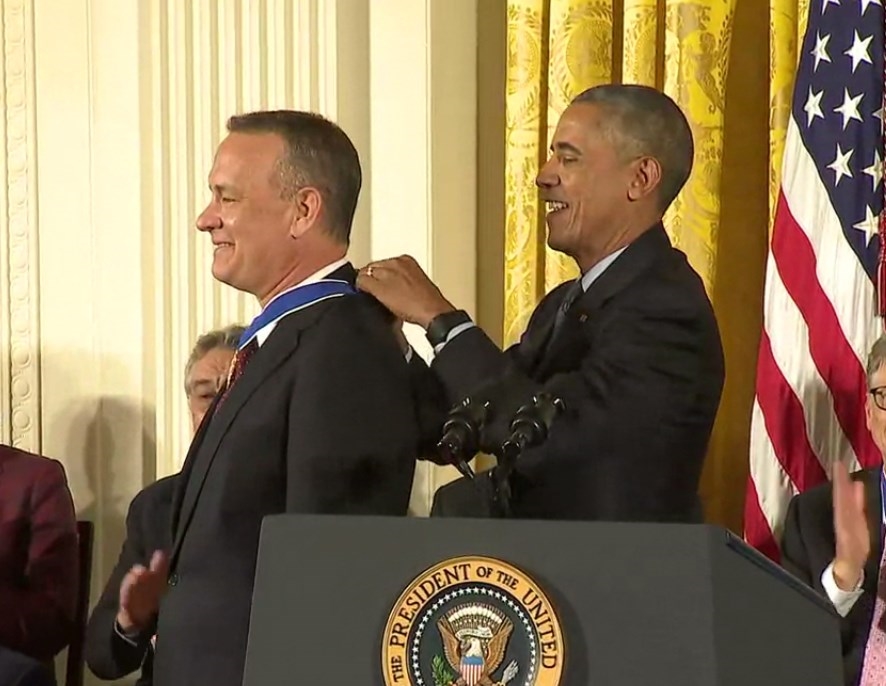 The White House, Public domain, via Wikimedia CommonsTom Hanks awarded the Presidential Medal of Freedom by President Obama, 2016That success has endured for more than three decades. Hanks continued to headline major films throughout the 2000s and 2010s, earning acclaim for performances in Cast Away (2000), Captain Phillips (2013), Sully (2016), and A Beautiful Day in the Neighborhood (2019). Beyond acting, he has used his influence to support numerous charitable and humanitarian causes. Following the September 11 attacks, Hanks participated in the America: A Tribute to Heroes telethon, which raised funds for victims and their families. Over the years, he has supported more than 30 charities and foundations, including UNICEF, Stand Up To Cancer, the American Foundation for AIDS Research, the Children's Health Fund, and the Red Cross.
A lifelong enthusiast of space exploration, Hanks serves on the Board of Governors of the National Space Society, where he advocates for greater investment in space research and exploration. He has also supported environmental initiatives, including the development and adoption of alternative fuels. His public service and cultural contributions were recognized in 2016 when he received the Presidential Medal of Freedom.
Hanks has also expanded his creative work through producing, directing, and writing. From a childhood marked by frequent moves and uncertainty, he built one of the most successful careers in modern film. His interest in space never led him to become an astronaut, but it remained a lifelong passion that continues to shape his public work today.
Page created on 6/21/2026 6:39:48 PM
Last edited 6/23/2026 12:54:30 PM
Kramer, Barbara. Tom Hanks: Superstar.Berkeley Heights, 2001.