REPRINTED WITH PERMISSION FROM THE CHRISTIAN SCIENCE MONITOR
Behind the fanfare of Johannes Klæbo’s feat is an extraordinary tale of focus and persistence that transcends his sport, or any sport. But he doesn’t see the tradeoffs as sacrifices, because it’s all in pursuit of something he loves.
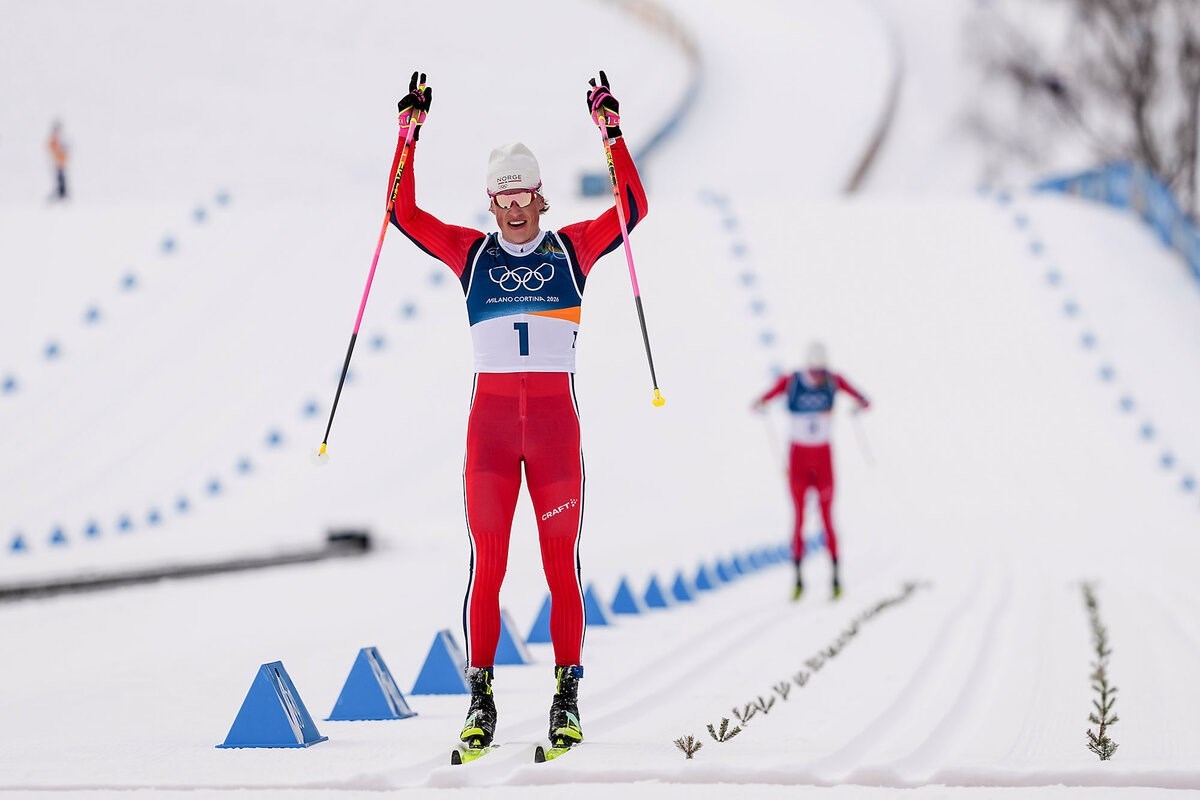 Johannes Høsflot Klæbo of Norway wins the cross country skiing men’s 50km mass start classic event at the 2026 Winter Olympics, in Tesero, Italy, on Saturday, Feb. 21, 2026. That earned him his sixth gold in six races at these Games, eclipsing U.S. speedskater Eric Heiden’s record of five golds. Evgeniy Maloletka/AP
| Milan
The greatest cross-country skier the world has ever known once admitted that, sometimes, he waits for the last moment to win.
There have been times, Johannes Høsflot Klæbo has said, that maybe he could have taken the lead earlier. But the legendary sprinter says there is something particularly satisfying in waiting for that few hundred meters – an exciting little bit of sporting “revenge” on those trying to beat him.
On Saturday, Mr. Klæbo got his revenge not against any racer, but rather the limits of what the world thought was humanly possible.
With his trademark surge up the final incline to at last leave behind Norwegian teammate Martin Løwstrøm Nyenget, Mr. Klæbo won the men’s 50km and his sixth gold medal in as many races at these Olympics.
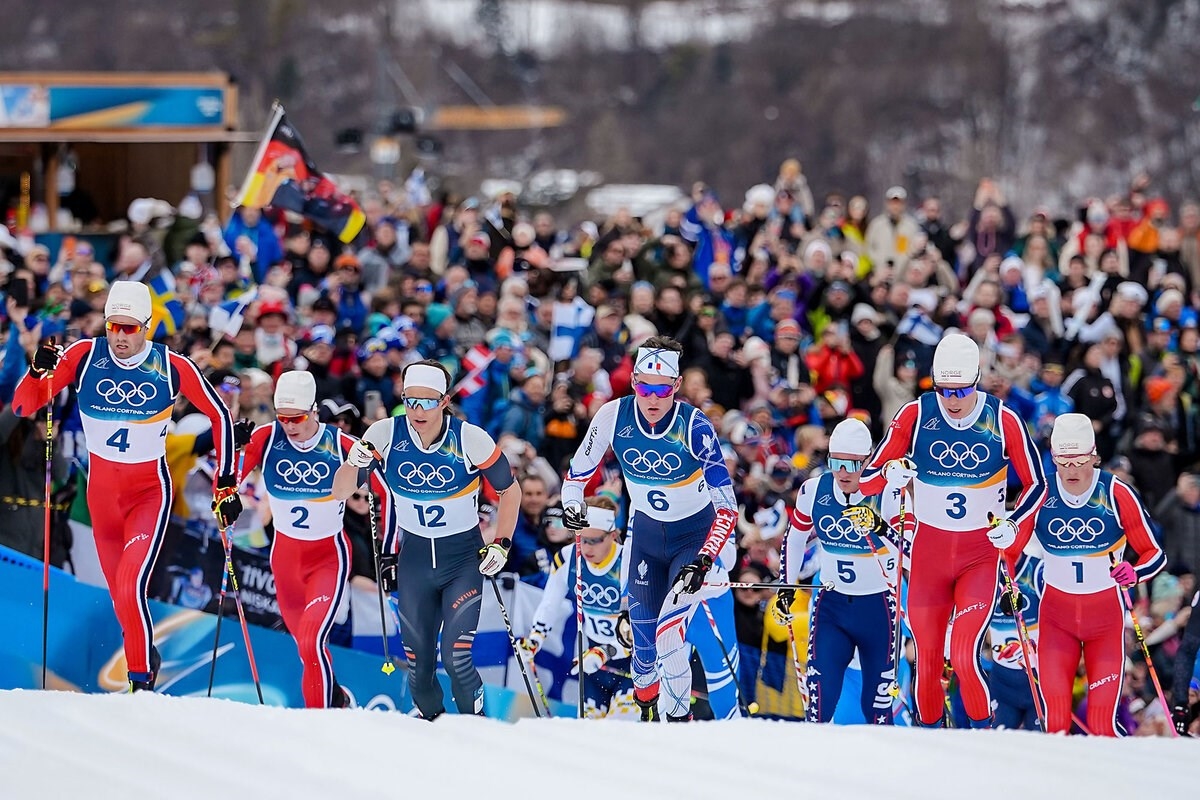 Matthias Schrader/APNorwegians Emil Iversen (left, wearing bib number 4), Martin Loewstroem Nyenget (bib 3), and Johannes Høsflot Klaebo (bib 1), compete in one of the most demanding Winter Olympic events: the 50km mass start classic cross-country race. The event was held in Italy’s Val di Fiemme region on Saturday, Feb. 21, 2026. The three Norwegians swept the podium, finishing third, second, and first, respectively.
The achievement creates a new standard of Winter Olympic perfection, breaking the record of five golds by American speedskater Eric Heiden in 1980. It also extends Mr. Klæbo’s record as the winningest Winter Olympian in history with his 11th gold medal, second only to American swimmer Michael Phelps’ 23 in the entire Olympic movement.
To anyone who witnessed Saturday’s race, where some of the fittest men on the planet were left gasping and retching over the course of the 31 miles, Mr. Klæbo’s achievement will seem a feat of astounding physical fortitude. Which, of course, it was.
But the story of Mr. Klæbo’s journey to this accomplishment speaks to something more than his unrivaled conditioning. It speaks to a 15-year-old boy who wanted to be the best in the world but wasn’t winning much of anything and what his journey since then says about the heart – and mind – of the champion he has now become.
The fact was, at 15, Mr. Klæbo was too small to beat the boys his age in the skiing hotbed of Trondheim, no matter his grand ambitions. But the grandfather who had given him his first skis at age 2 (which a young Mr. Klæbo had then used to ski around the living room) had a plan.
“They decided to put a lot of focus on the technique, because they knew that, someday, he would grow up and get muscles,” his mother, Elisabeth Klæbo, told The Athletic.
Some racers might wish Mr. Klæbo had grown faster and so would have put in less work. “He’s so good in every technique and part of the race, and also tactically,” said Swiss sprinter Valerio Grond to the FasterSkier website in 2024, when the Norwegian had won 10 sprint races in a row.
The best way to beat Mr. Klæbo? “Maybe break his poles or something? I don’t know,” he quipped.
Those early habits became the foundation for the greatness that has followed. Mr. Klæbo and his grandfather Kåre still talk every day, and they’re still making plans. There’s even a Norwegian book called “Johannes and Grandpa.”
“He’s 83 years old but still the most innovative guy that I know,” Mr. Klæbo told the International Ski Federation website. “He’s reading books and all kinds of scientific material to see what we can improve all the time, and that’s special.”
The two clearly aren’t afraid to try new things. When Mr. Klæbo found his skis were too slippery in one race, he abandoned his usual technique and just started running up the hill. It has since become his signature move, dubbed the “Klæbo Run.” Mr. Klæbo even poked fun at himself with a video, evoking a classic scene from “Forrest Gump,” in which he runs down a road on skis wearing khakis.
But it is Mr. Klæbo’s mental discipline that sets him apart, including eating and even sleeping with fanatical rigor.
Those demands have at times been severe. Particularly, his determination to isolate himself from friends and family in preparation for big races, like the world championships in Trondheim last year, where he won all six races – setting the stage for this Olympic sweep.
On the Skirious Problems podcast with two fellow racers, he talked about his girlfriend’s sister, who has 8- and 10-year-old kids. “They asked their mom last year whether I was still their uncle. That one hit a little bit,” he said. He has also decamped to Utah in the summers to train, not just for its high altitude but the sense of solitude; few there recognize the world’s best cross-country skier.
He now says he is beginning to find some balance. For him, that meant allowing himself to stay up late two consecutive nights to be with family last year during the release of a biographical film about him, he told the podcast.
No word on whether he allowed himself to hit the snooze button the next morning.
No other human has won 11 gold medals at the Winter Olympics, so maybe he’s on to something.
For more than half of Saturday’s race, Mr. Klæbo was part of a red-suited convoy seemingly determined to put an exclamation mark on Norway’s Winter Olympic dominance.
He, Mr. Nyenget, and countryman Emil Iversen had left the rest of the field behind by the halfway point. By 28 miles (46 km) in, Mr. Klæbo and Mr. Nyenget had pulled away from Mr. Iversen, who finally accepted what all but one of the 63 other races knew: He was not beating Mr. Klæbo.
But Mr. Nyenget endured. Perhaps for dramatic effect. When Klæbo finally dropped him on the final incline, more than 30 miles into the most punishing event of the Winter Games, it was not quite the “Klæbo Run.” But it was close. And it then became clear to Mr. Nyenget that he, too, would not be winning gold.
“It seems like I managed to get rid of most of the best skiers in the world, but the best one was still there,” said Mr. Nyenget after the race, in which he, Klæbo, and Iversen swept the podium for Norway. “I’m really happy about my performance but Johannes is the king.”
For his part, Mr. Klæbo was in no doubt of what had happened, or why. “It’s a lot of sacrifices, but on the other hand, when you’re starting to feel that it’s sacrifices, I think it’s time to find something else to do,” he said.
It’s not time.
He and his grandfather have already come up with a plan to get to 2030. The 2034 Olympics are not out of the question, either. They’re in Utah, after all, and he’d love to compete in his adopted summer home, he says.
Who knows, his neighbors might even recognize him now.
Page created on 2/22/2026 3:43:03 PM
Last edited 2/22/2026 3:53:24 PM