REPRINTED WITH PERMISSION FROM THE CHRISTIAN SCIENCE MONITOR
Mikaela Shiffrin’s gold medal in the slalom was a monumental sporting achievement. She not only set the second-largest winning margin in Olympic Alpine history, but she also subdued Olympic-sized fears.
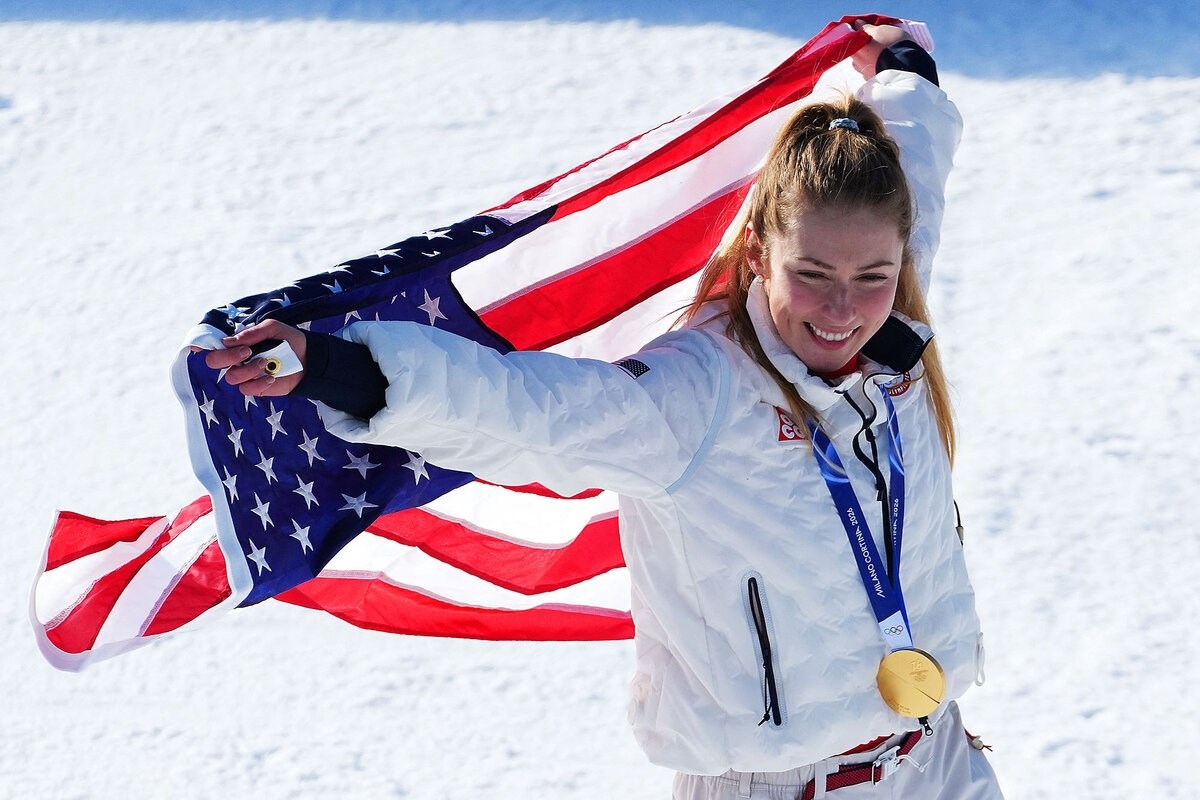 Gold medallist Mikaela Shiffrin of the United States celebrates with an American flag following the women’s slalom event in Cortina d’Ampezzo, Italy, Feb. 18, 2026. Aleksandra Szmigiel/Reuters
| Cortina d’Ampezzo, Italy
At the end of perhaps the biggest race of her historic career, before taking in what the scoreboard said or what the roar of the crowd surely meant, Mikaela Shiffrin took a moment to be grateful.
The crowd waited, expecting some outpouring of relief or elation – something to show the crushing weight of Olympic expectation lifted. But there was nothing except the new Olympic slalom champion, silent, head bowed for many beats beyond the ordinary.
She was grateful she had skied the kind of runs she wanted to ski, whatever the result. She was grateful for those who had helped bring her to this moment – over a lifetime and a tumultuous two weeks. And she was grateful that, perhaps for the first time since the death of her father six years ago, she was starting to feel something that was perhaps a little more whole.
It was a moment Ms. Shiffrin wanted to slow down – a testament to her Olympic priorities at last set straight. She had been chasing the clock her whole sporting life. For once, it could wait for her.
Ms. Shiffrin’s gold medal in Wednesday’s slalom was a monumental sporting achievement. In winning the race by 1.5 seconds, she not only set the second-largest winning margin in Olympic Alpine history, but she showed the world her reality. This is what she does. This is who she is.
But, ever thoughtful, Ms. Shiffrin did something more. She let the world in. Her life as the greatest skier in the history of the sport has not been built on confidence, she said afterward, but often on debilitating fear. After every race, she said, her first thought is: Will I be able to do it again? “Because I know how much it takes, how much effort and precision,” she said. “And I don’t know that I can do it again.”
In that way, the numbers on the scoreboard Wednesday – though historic – were somewhat incidental. Ms. Shiffrin’s real journey in Cortina this year has been learning how to overcome the fears that have always been there, just magnified to Olympic proportions every four years. And for that quiet moment at the bottom of her Olympics-winning second run, she knew she had already won in ways the clock could never understand.
“These moments, we do build them up, for sure. I think everybody builds it up, and I’ve been building it up for myself too,” Ms. Shiffrin said after the race. “The biggest task today was to simplify and focus on the skiing. But I had some moments today where I could imagine doing the skiing, crossing the finish line, and having this moment kind of for myself.”
“I can’t even explain what it feels like to cross the finish line and know before I saw the time that I did that skiing,” she added.
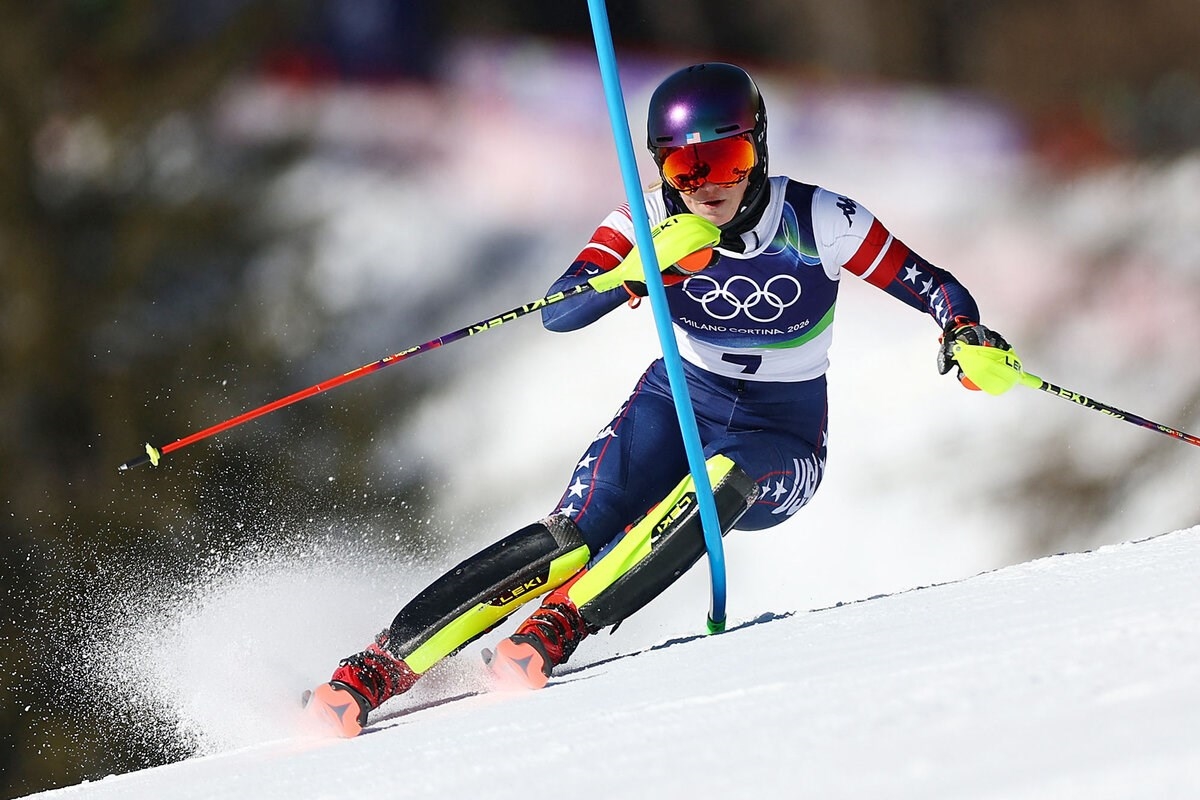 Lisi Niesner/ReutersMikaela Shiffrin of the United States in action during her first run in the women’s slalom at Tofane Alpine Skiing Centre, in Cortina d’Ampezzo, Italy, Feb. 18, 2026.
The tears that inevitably came offered some indication. As did the little leaps of joy she did with Camille Rast of Switzerland (silver) and Anna Swenn Larsson of Sweden (bronze) on the medal stand. It was as if the 18-year-old Mikaela, kept safely out of sight since she last won Olympic slalom gold at the 2014 Sochi Olympics, was finally set free. Afterward, she said as much.
Since coming in fourth in the slalom in the 2018 Pyeongchang Games, she felt the Olympics were warping her reality. On the World Cup tour, she was on her way to amassing the most wins of any skier in history. But the questions she would get at the Olympics “didn’t feel like they lined up with the reality of our sport,” she said.
They were all about her disastrous Beijing Olympics. Or why she could not seem to hit the heights of her World Cup triumphs when the Olympic lights were on.
Part of her journey was accepting she could do nothing about it. A missed gate, a stumble, and she would be facing those same questions in another four years – or for the rest of her life.
“In order to do this today, I kind of needed to accept the possibility that those questions would keep coming,” she said. “You know, it was like, just don’t resist it.”
For someone who acknowledged that her greatest challenge is in accepting uncertainty, that was both terrifying and freeing. It meant finding new strength.
“The worst things that people might say about me, I will listen to it, and I’ll agree with it, actually,” she said on Wednesday. “I’m like, ‘You’re right, I’m worthless.’”
So this time, she tuned out all social media. She even went so far as to unsubscribe from media that she likes just to keep guard over her thoughts.
Yet she found she needed to go deeper. It led her to do something she admits she’d never really done before. She had to address the fear head-on, sometimes out loud.
“Normally, I don’t really talk to myself in this way,” she said. “But I’ve had to be actually, like, loud with myself to say, ‘You want a big mentality. You want to earn the moment. You want to do this ski. ... You want to be in that start gate, and then you want to take on the course ahead of you.’”
Along the way, she found herself wrestling with things that she had never truly handled, like her father’s death. “Everything in life that you do after you lose someone you love is like a new experience. It’s like being born again. And I still have so many moments where I resist this. I don’t want to be in life without my dad,” she said, holding back tears.
Before Wednesday’s race, however, something in her thinking had changed. “Maybe today was the first time that I could actually accept this,” she said. “Instead of thinking I would be going in this moment without him, to take the moment to be silent with him.”
Even if that was at the finish line of the Olympic slalom. Or, perhaps, precisely because she was at the finish line of the Olympic slalom.
Ms. Shiffrin has always been an athlete of uncommon honesty and directness. In skiing, this earnest determination to put in the work – to do things the right way – has pointed her the straightest way down the slope and into history. But here at the Olympics, it has been perhaps her one great vulnerability. The Olympics do mean more. And so they meant more to her, too. She talked about almost being scared to win – to deal with the emotions the Olympics dredged up.
So this gold will not just be another sparkly thing in her already overstuffed award cabinet. It will be a reminder of the time she faced so much she could not control, yet found her way through all the unexpected turns down a completely different kind of mountain.
It took her somewhere familiar – back to basics. Two skis, a slope, and 64 perfect-as-possible turns to the finish. “It’s not always easy. Sometimes it feels impossible. But in the end today, it was to take away the noise and to just be simple with it,” she said.
The journey did not leave her where it found her.
“It was just a little bit more spiritual than I usually am,” she said. “But I’m really grateful for that.”
Page created on 2/22/2026 3:18:19 PM
Last edited 2/22/2026 3:28:19 PM