“The world is moved along, not only by the mighty shoves of its heroes, but also by the aggregate of tiny pushes of each honest worker.” People often link the word “hero” with magical powers and unseen acts of triumph. However, it isn’t only the superheroes that create the biggest impact. This quote was said by no one other then Helen Adams Keller. Although she saw herself as an “honest worker,” Helen Keller was seen by the world as one of the few aspirant heroes. Heroes endure and persevere through every bump on the road. They exceed their limits and strive for the betterment of others. They leave the world, having made it a better place. Helen overcame the difficulties of being blind and deaf to become one of the most renowned humanitarians of her time. She saw her impediments as a pebble on the great road of her journey to success.
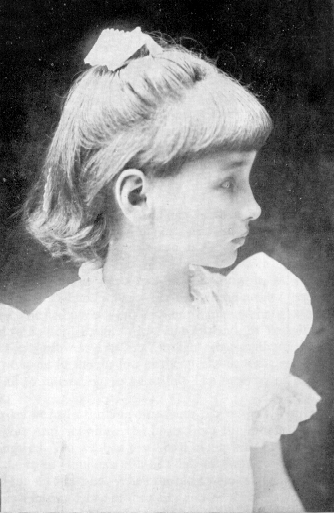 |
| Helen Keller as a young child (http://www.hermes-press.com/helen1.jpg) |
On June 27, 1880 in Tuscumbia, Alabama, Helen Keller was born a healthy baby girl. At the fragile age of 19 months, Helen Keller became ill with what doctors called a “scarlet fever.” Fearing her survival chances, her parents, Captain Arthur H. Keller and Katherine Adams Keller, could only hope she would make it. To their gratefulness, Helen Keller quickly recovered. However, what both her family and doctor didn’t know was that the illness hadn’t left her without taking something in return. The fever had left Helen both blind and deaf. As she got older Helen seemed to show more and more boisterousness that her parents couldn‘t control. Her family knew she needed help. They knew that Helen didn’t just need a teacher, she needed a mentor, a supporter. In 1887, Helen Keller began her journey towards becoming a paramount activist when she met her mentor Anne Sullivan. As she got older, with the help and support of Sullivan, Helen started showing signs of great intelligence. “Sullivan then took Keller to the Horace Mann School for the Deaf, where she made remarkable progress in learning to speak English and even French and German” (Discovering Biography). Every obstruction was seen by Helen as an opportunity to prevail and prove that she was much stronger than perceived. Every time there were challenges that Helen could easily turn away from, she, instead, proceeded towards her dreams, and refused to give up. She refused to accept the life of silence filled darkness. Keller, continued to prosper with the motivation and faith of her companion and teacher, Anne Sullivan. Together they made history. “Helen made History in 1904. She was the first deaf and blind person to graduate from college. She graduated from Radcliffe College with honors” (startASL - American Sign Language). To the astonishment of people, Helen had not only made history, she had proved that no disability limits your boundaries and that no dream is worth giving up on.
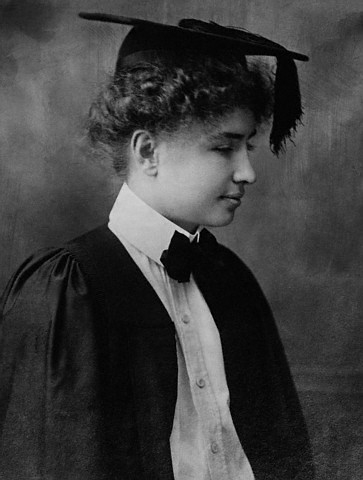 |
| Helen Keller as a proud graduate (http://www.gardenofpraise.com/images/keller2.jpg) |
Now that she succeeded in capturing people’s applaud, she set out to capture their hearts. “After conquering her own limitations, Keller’s next battle was the public’s indifference to the welfare of the disabled. She devoted the rest of her life to promoting social reforms aimed at bettering the education and treatment of the blind, the deaf, the mute - in effect, many physically challenged people” (Discovering Biography). After writing her book The World I live In in 1908, Helen Keller proceeded to become the founder of Helen Keller International (HKI) in 1915. She created this foundation in her belief that “the welfare of each is bound up in the welfare of all.” The nonprofit organization started in hopes to help the blind, needy, and reduce malnutrition among the world. Nevertheless, for Helen, help just wasn’t enough. She wanted to spread the awareness of the adversities of having disabilities. She traveled around the world lecturing about the need to improve the lives of the disabled and the idea that we could achieve a better world in doing so. Despite her many challenges, Helen strived towards her ultimate goal to help them less fortunate and eliminate indifference. Her years of devotion, dedication, and labor took on straight to people’s hearts. She earned the honor and position of “a respected and world-renowned activist who labored for others” as said by the American Braille Press. In 1932, Helen once again succeeded to win against indifference when Braille was accepted as the world's standard alphabet for the blind. She continued her climb until when in 1936, Helen lost something that even her resilient vigor couldn’t handle. Anne Sullivan passed away in 1936. This left Helen shaken. Even so, as her strength had proved to do so before, she recovered, moving onto greater depths of achievement. From 1946-1957, after countless visits to several countries, the Government began schools for the blind and deaf. This accomplishment took Keller to a whole new level of respect that she both received and returned. In 1956 she was given recognition for being the first woman to receive an honorary degree from Harvard University. As Broadway called her, Helen Keller genuinely was “The Miracle Worker”. In 1964, Helen decided to end her public life after suffering a stroke. Only 4 years later, at the age of 88, Helen Keller passed away.
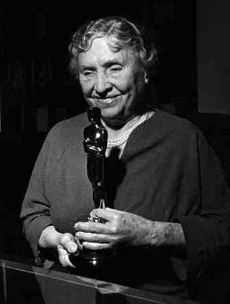 |
| Helen Keller in her later years (http://www.spiritualityandpractice.com/days/images/photos/helenkellerlrg.jpg) |
“Life is beautiful,” Helen Keller had once said. She saw the outmost beauty of the world not through her eyes but through her vision. In spite of her shortcomings she has expressed that she found life to be so beautiful. Although after her death, people felt the world had lost an angel, her inspiration and impact continue to live on even today. Helen Keller International (HKI) is now among the few of the oldest nonprofit organizations that is preventing blindness and still strives in an effort to eradicate malnutrition across the world. After Helen Keller, the lives of the disabled were changed forever. She believed that it was an utmost duty for people to care for each other, handicapped or not. To herself, Helen was an “honest worker”; to the world she is a deserving hero. Giving hope to people that otherwise would not have any, earning honor and respect, she overcame every obstruction in her way no matter how big. She never once gave up on her hope for a brighter future. She left the world, a much better, much more tolerant, and a much more inspired place.
Page created on 2/12/2010 12:00:00 AM
Last edited 2/12/2010 12:00:00 AM
Keller, Helen. The Story of My Life. New York: Bantam, 2005.
World Encyclopedia. "Helen Adams Keller." Gale. 2004. volume 8
biography.com. "Helen Keller." [Online] Available http://www.biography.com/articles/Helen-Keller-9361967.
Gale. "Keller, Helen (1880 - 1968)." DiscoveringBiography. 2003.
Vicars, William. "Helen Keller - The First Deafblind College Graduate." [Online] Available http://www.start-american-sign-language.com/helen-keller.html.