 |
| (http://articles.sfgate.com/2008-11-02/books/20872711_1_john-muir-donald-worster-passion) |
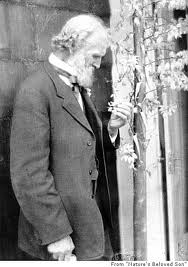
“I only went out for a walk and finally concluded to stay out till sundown, for going out, I found, was really going in,” (Muir). John Muir helped nature out, and in return, he realized it's natural beauty. Because of his strong understanding of nature, he felt like he needed to protected it. The strong love he had for the world around him caused him to persevere, and save many national parks. His birth took place in 1838, in Scotland. When he was eleven, his family, which included his dad, mom, and eight siblings moved to Wisconsin. They had a farm, in which Muir’s strict father made him work in. His father didn’t want him wasting the day reading and studying, so Muir made his first invention which woke him up early, like an alarm. This allowed him to wake up and be able to do both study and work. This small contraption allowed him to become smart and inventive. In 1860, he shared many more of his inventions at the Wisconsin State Fair. The year after, he attended the University of Wisconsin, where he studied science. During college, he tried to study medicine, but it didn’t interest him in the same way as nature and his inventions did. However, in 1867, he stopped inventing things, and decided to dabble in the religious job; he learned about God and what he created. Later, in 1880, he married his wife, Louie Wand. He later moved with his two daughters and wife to California, because that's where his wife's family lived. After the move, he saved many national parks, including Yosemite. Throughout his life, John Muir accepted and nurtured the things around him. Because of this, he was very heroic, although he wasn't conceited. His life philosophy was to help the environment around him, and make his family comfortable. John Muir demonstrated compassion and an open mind, which makes him a hero.
 |
| (http://www.martinfrost.ws/htmlfiles/gazette/significant_scots1.html) |
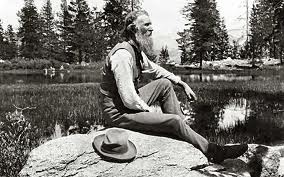
John Muir was flexible when it came to anything; he had an open mind, and was very relaxed about change. He changed jobs quite often, and he didn't care if the jobs had no connection to each other,
"John Muir was many things, inventor, immigrant, botanist, glaciologist, writer, co-founder of the Sierra Club, fruit rancher. But it was John Muir's love of nature, and the preservation of it, that we can thank him for today” (National Park Service). Muir was not only an inventor, he did many other things too. He didn't want to stick to one thing; he decided to see what else was out there in the world. His curiosity of the world around him, caused him to not be scared, and to take a chance and explore new alternatives. At one point, Muir became interested in exploring new careers, “in 1867 he made the career decision he never regretted: to give up his own inventions 'to study the inventions of God,'" ("John Muir." Encyclopedia of World Biography. Detroit: Gale, 1998. Gale Student Resources In Context. Web. 10 Jan. 2011).Muir made a decision that could have affected him drastically. Job changes can be very tough, because one does something they may not be use to, yet Muir did. Although it was risky, this change, turned out to be very fitting for Muir. He enjoyed it, and it had an impact on his life. Because John Muir was so perceptive, he actually was rewarded for exploring more than one area. He not only thought openly, he thought with his heart.
 |
| (http://www.newworldencyclopedia.org/entry/John_Muir) |
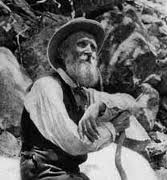
John Muir, an environmentalist, cared about the world around him. Muir acted very strongly for what he believed in, “in 1889 Muir argued in Century Magazine that Yosemite Valley should become a national park. The passage of legislation for that in 1890 owed much to his influence” ("John Muir." Encyclopedia of World Biography. Detroit: Gale, 1998. Gale Student Resources In Context. Web. 10 Jan. 2011. ). When a person is very passionate for something or someone, they do whatever it takes to help it. They don't give up, and they keep trying. He cared very much about Yosemite, so much, that he argued to save it. His determination proved that he loved nature with a strong heart. Although he he cared for the environment, his family still claimed a spot in his heart, “Muir chose to live in this urban environment because his wife Louie, and her family were from here" (National Park Service). His compassion for his wife is shown by the move he made; he did it so that she could be near her family. When someone loves another, they make sacrifices, no matter what. Moving can be a tough thing to do, but he did it for a loved one. He's willing to make sacrifices for someone he truly loves, which shows he's willing to endure any hardship for the things he cares about in his life. He cherishes many things, and is willing to forgo any problems that may come with the effort to help them. Being a caring person will get you far in life.
 |
| (http://www.nms.ac.uk/highlights/objects_in_focus/fossilised_tree_slice.aspx) |
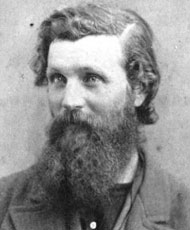
John Muir deserves the title hero, because of his many attributes. His caring and open-minded personality helped him to look past all the effects that change might have. Muir had the character of a persistent person trying to save something they love. Not only was he an environmentalist, but he also had a family he cared for. He was a person who cared with an open heart, and he continually helped to save the environment, and take care of his family. He is someone to look up to, someone to learn something from. Whether it's to take action for the things you love, or just try to keep an open mind, we can all take some advice from John Muir.
"Commentary on Excerpt from The Yosemite." World War I and the Jazz Age. American Journey Online. Woodbridge, CT.: Primary Source Microfilm, 1999. Student Resource Center - Junior. Gale. DEL NORTE HIGH SCHOOL. 15 Dec. 2010
Gifford, Terry. "Muir, John 1838–1914." Encyclopedia of Environmental Ethics and Philosophy. Ed. J. Baird Callicott and Robert Frodeman. Vol. 2. Detroit: Macmillan Reference USA, 2009. 76-78. Gale Virtual Reference Library. Web. 13 Dec. 2010.
"John Muir." Encyclopedia of World Biography. Detroit: Gale, 1998. Gale Student Resources In Context. Web. 9 Dec. 2010.
"John Muir National Historic Site (U.S. National Park Service)." National Park Service. fdsfU.S. Department of the Interior, 08/12/09. Web. 17 Dec 2010. faff "The National Parks: America's Best Idea: People - John Muir." PBS. The National fdafParks, Not Found. Web. 17 Dec 2010. fdaf
Page created on 1/19/2011 12:00:00 AM
Last edited 1/19/2011 12:00:00 AM