Celebrating Everyday Heroes
Tell the world about your hero

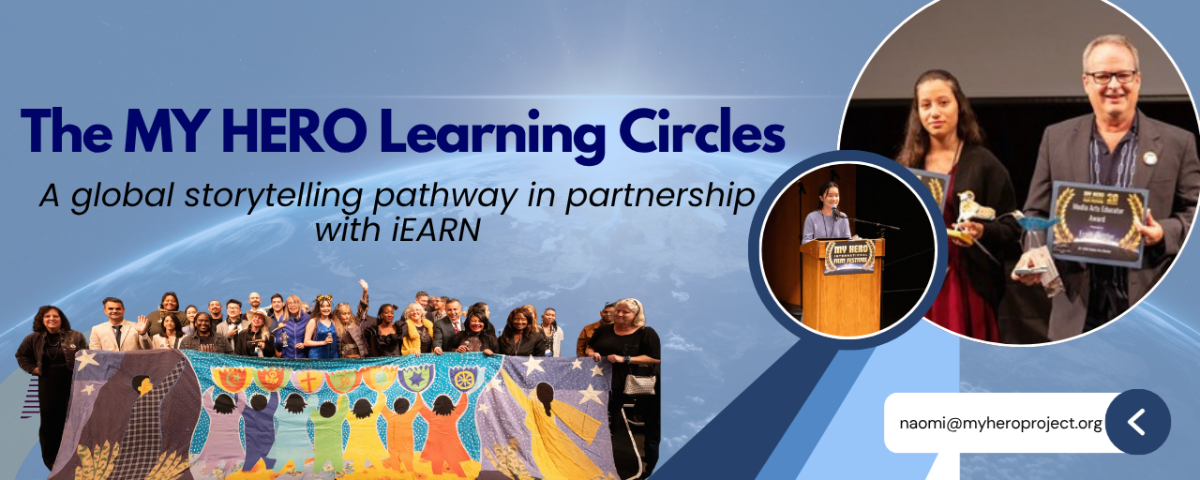
Welcome to the Celebrating Everyday Heroes pathway! With tools provided by MY HERO, students identify a hero in their family, community or the wider world; investigate that person’s actions and impact; create an original story, artwork or short film; exchange feedback with partner classrooms; and submit the finished work to MY HERO for review and possible publication.
Overview of this pathway:
Choose → Research and verify → Plan → Create → Review and clear → Submit → Exchange → Optional action
MY HERO First Steps
Before you begin, make sure you have completed the MY HERO First Steps from the Learning Circles landing page. If you need any help at all completing those steps, please don’t hesitate to reach out to me at [email protected].
iEARN participants: You can also post your introductions in the “Welcome & Introductions” discussion board in the iEARN collaboration centre. If you have any questions throughout the process you can post them on the Project Question & Answers” discussion board or email me directly at [email protected].
Choose your hero
Students will choose the hero that they want to focus their project on. We have several resources to help students with this!
For students with a higher reading ability, I would recommend How to Choose Your Hero by Charles Harper, modified by Coleen Bondy. For younger readers and multilingual learners I have adapted the essay to make it a little easier to understand.


Once students have read the essay, they can explore examples of heroes that are featured on the MY HERO website. Each hero listed has a story for early readers (always featured first) and more experienced readers (featured second), so you can find the content relevant to your class! Click the banner below to explore.
Now students have had some inspiration, they can discuss heroes, heroism, and who inspires them, both in the classroom and on the forum. Students, we want to learn about YOUR heroes in your countries, communities, and families!
iEARN Participants: Once you’ve made your choice, you can share your selection on the "Choosing your hero" discussion board in the iEARN Collaboration Centre.
Choose a medium
Now that students have chosen their hero, it’s time to choose what type of project they would like to create! Will students work individually or in groups? Students can submit either a short film, story, or artwork for publication.
Explore examples of films, stories, and art on MY HERO by clicking on the banner below.
Students who choose to make a short film may use the MY HERO Journalism & Filmmaking Workbook for advice on how to create their film. To request your free download, click here and fill out the workbook request form.
Research your hero
When researching your hero, these questions are a great place to start!
One strategy that will save you a lot of time and energy is to begin your research from a reliable starting point. Using a search engine like Google can be useful, but it’s not necessarily where you should start. Here are some places to begin:
Your Public and School Libraries:
Public libraries are an excellent place to conduct research. Going to a physical library and asking a librarian for help is like getting a free, experienced research partner to assist you. You also likely have access to an online library, with many databases paid for by the library so that you can access reliable sources. Most libraries allow you to get a library card online or very easily in-person at your local branch. Your school library likely provides similar resources. Use the library — you won’t regret it!
Free databases:
Schools and local libraries often provide some of the best research databases around, with free access to academic studies and news and magazine articles. In addition to library databases, you also might consider these free research tools.
The MY HERO Journalism and Filmmaking Workbook has a great chapter on how to conduct research. Click here to read.
Plan your project
Students, now that you’ve completed your research it’s time to put together a plan! Everyone will have their own method of planning, but below are some useful steps to follow based on the medium you have chosen.
Films:
Stories:
Art:
Create your project
Students now spend time creating their project and uploading to the MY HERO site. Like with planning, everyone will have their own way of working… However, to try and ensure students are on the right track during the process, I have put together a rough guideline for students to follow.
Films:
Stories:
Art:
Students, this is an opportunity for you to create a meaningful piece of work that you can be proud of. Enjoy the process, and don’t be afraid to reach out to others for feedback throughout the process!
iEARN participants: You can post questions or sections of your work in the “Feedback” folder in the iEARN Collaboration Centre.
Submit your work
Before you create or submit
Please ensure you have checked the following:
Congratulations to all the students on completing your hero projects! You should be extremely proud of yourselves.
The links below include useful tutorials on how to use the MY HERO Create program to upload students’ work for review. Should you or your students run into any difficulty with this process, please reach out to me at [email protected], and I’ll be more than happy to help you!


Educators, you can now create a showcase organizer full of all your students' approved work. For a tutorial on how to create your organizer, click the image below. Once you have created your organizer, you can share the link!
iEARN Participants: To complete the exchange, visit at least one partner class’s organizer and post a thoughtful response in the iEARN Collaboration Centre. There is a discussion board for this marked "Organizers."
If appropriate, students could submit their projects to one of the MY HERO contests. For more information about the various contests at MY HERO and how to enter, click the banner below.

Optional: From Story to Action
In 2015, all United Nations Member States adopted the 2030 Agenda for Sustainable Development. Its 17 Sustainable Development Goals provide a shared framework for people, planet, peace and prosperity.
Learn more about the 17 Sustainable Development Goals here.
Educators, we have a range of resources on the UN's Sustainable Development Goals here.
Which United Nations Sustainable Development Goal connects most closely to your hero’s work? What is one realistic action you or your class could take to support the same goal?
Write a short paragraph connecting your hero to a global goal. You could use the following prompt to get you started:
“My hero contributes to SDG ___ by ___. One action I or my class could take is ___.”
Closing the circle
We have reached the end of the MY HERO Learning Circle: Celebrating Everyday Heroes! A huge congratulations again to you all for having completed the program. MY HERO loves to see work created by students – it’s at the very core of what we do. In creating and sharing your hero projects, you have shared a little bit of hope and joy with the world.
iEARN participants: I would like to invite everyone to post their final goodbyes to the "Final Reflections" discussion board in the iEARN collaboration centre, which will remain active for another week as the MY HERO Learning Circle closes. Thank you all again, and we hope to see you in the next session!
Explore MY HERO Resources
Short Films that Introduce MY HERO


Learn about the MY HERO Teachers Room and all it has to offer!
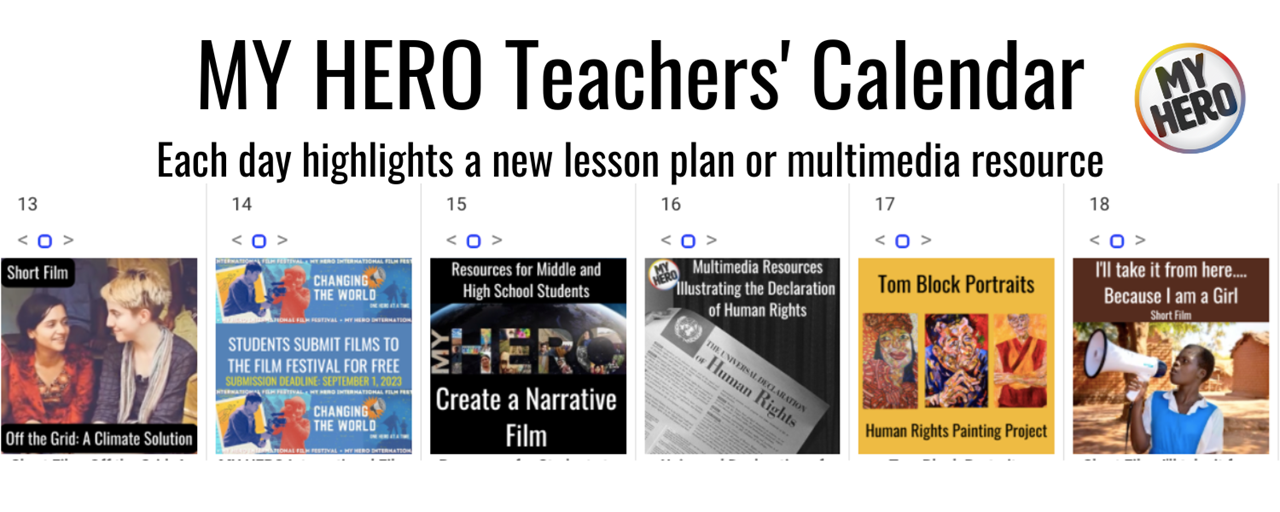
Teachers' Calendar and Monthly Lesson Plan Resource Links
Organizer created on 1/2/2020 1:13:48 PM by Laura Nietzer
Last edited 8/23/2026 11:54:16 AM by Naomi Gledhill